
Drawer Slide Measurement Guide
How much side clearance do drawer slides need?
For COREAX LD2053 and L2576 side-mount slides, plan approximately 0.75 in / 19 mm per rail, or 1.50 in / 38 mm total. Measure the actual pair before cutting the drawer, because fastener heads, frame accuracy, and release access can still change the finished fit.
- Published by
- COREAX
- Technical review
- COREAX Product Support
- Published
- Updated
Direct answer
Subtract both rail thicknesses before you build the drawer.
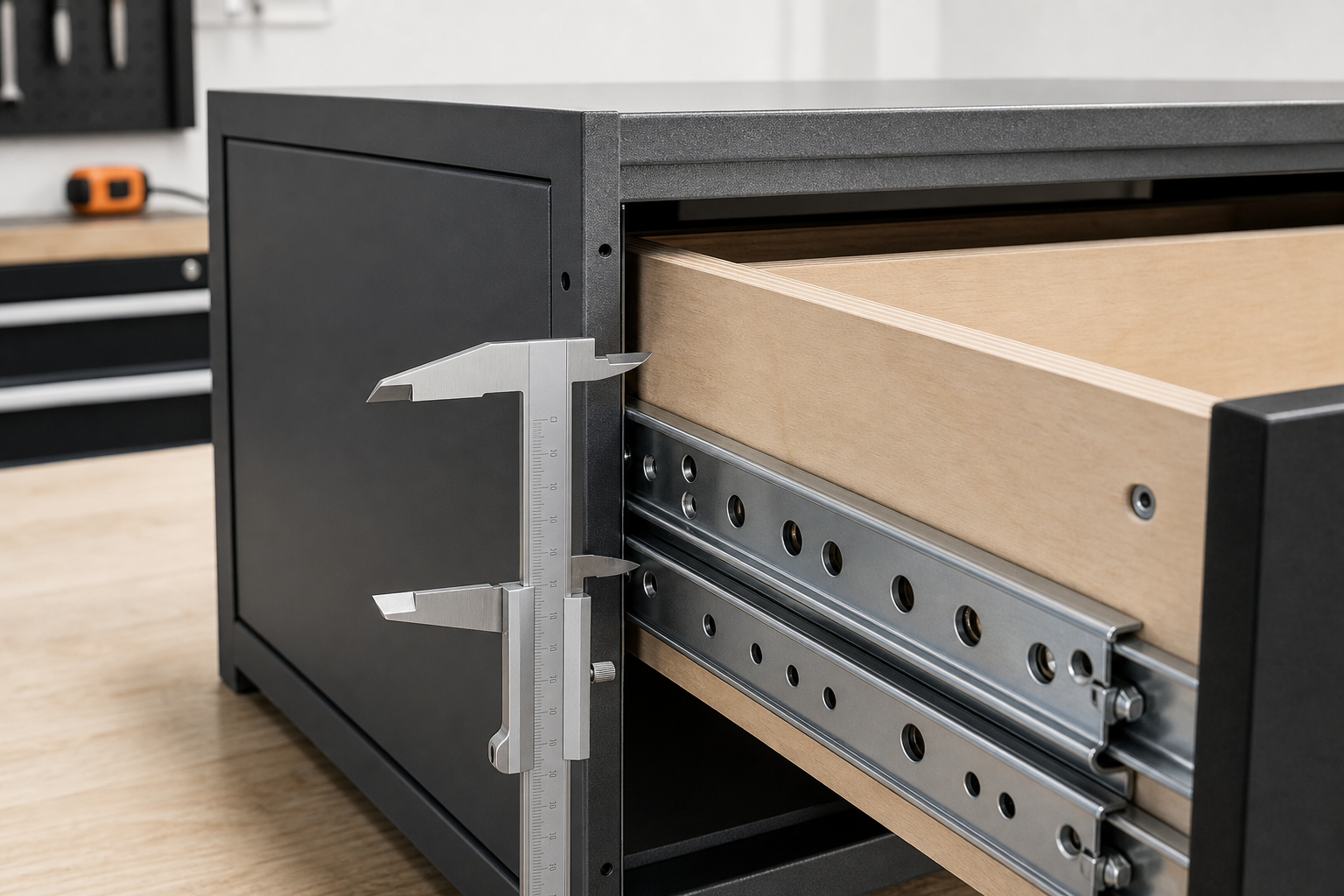
For the current COREAX LD2053 and L2576 side-mount families, use 0.75 in / 19 mm as the nominal space for each rail. The theoretical drawer outside width is the clear opening minus 1.50 in / 38 mm. Do not treat that result as a cutting dimension until you have measured the actual pair, checked the front and rear opening, and allowed for the installation tolerance required by the selected slide and frame.
Sizing formula
Use the smallest measured opening width.
Example: a 36.00 in opening with two measured 0.75 in rails gives a 34.50 in theoretical drawer outside width. If the opening measures 36.00 in at the front but 35.94 in at the rear, calculate from 35.94 in and then apply the exact installation tolerance for the selected hardware.
Measurement sequence
Five checks before cutting the drawer box.
- 01Measure at rail height
Measure the clear opening at the front, middle, and rear on the same horizontal line where the slides will mount.
- 02Use the narrowest reading
A frame that narrows toward the rear can bind even when the front measurement looks correct.
- 03Measure both rails
Use calipers or a reliable rule on the actual pair. Do not assume every side-mount slide uses the same side space.
- 04Check interference
Confirm screw heads, bolt heads, drawer faces, lock levers, and linkage parts do not enter the moving path.
- 05Test before final tightening
Mount loosely, cycle the unloaded drawer, add load gradually, and confirm both rails remain parallel through full extension.
COREAX specifications
The same nominal side space serves two different release systems.
| COREAX family | Nominal rail thickness | Total nominal side space | Additional access check |
|---|---|---|---|
| LD2053 single-side release | 0.75 in / 19 mm per rail | 1.50 in / 38 mm | Leave finger clearance around the selected release side and drawer face. |
| L2576 linkage-ready locking slides | 0.75 in / 19 mm per rail | 1.50 in / 38 mm | Leave room for both L-shaped levers or the builder-supplied linkage. |
| Other side-mount slides | Use the exact product specification | Twice the measured rail thickness | Verify disconnect levers, brackets, tabs, and screw-head paths. |
Tolerance and trial fit
Separate nominal rail space from the tolerance used to make the installation move.
The 19 mm-per-side figure describes the nominal COREAX rail profile; it does not tell a builder to make the drawer exactly 38 mm narrower and ignore every other condition. The finished fit must also accommodate the exact pair, the squareness of the drawer, the straightness of the mounting faces, and any tolerance stated for the selected hardware. Do not invent a large extra gap as insurance: excessive looseness can let a wide drawer twist and can make lock engagement less consistent.
A safer sequence is to build or mock up the drawer near the calculated width, attach the rails with a limited number of accessible fasteners, and cycle the assembly before installing the drawer face or filling unused mounting holes. Check the closed position, middle travel, full extension, both lock positions, and release movement. Then add representative load gradually and watch whether the frame spreads, the drawer sags, or one rail begins carrying more friction than the other.
If the trial fit is tight, locate the cause before reducing the drawer width. Compare front, middle, and rear spacing; inspect each screw head; check whether the drawer box is racked; and loosen staged fasteners to see whether the mounting surface is pulling a rail out of line. Removing material from the drawer may hide the symptom while leaving a tapered frame, protruding fastener, or flexible structure unresolved.
Fit diagnosis
What wrong clearance looks like.
Evidence note
Side space is a model specification, not a universal drawer-slide number.
Manufacturer evidenceAccuride publishes 0.75 in side space for one heavy-duty side-mount model, while other official Accuride product listings use narrower values such as 0.29, 0.30, 0.38, and 0.50 in. The practical rule is therefore to measure and follow the exact slide model—not to reuse a number from another rail family.
- Accuride 3600AD product documentationOfficial example of a heavy-duty side-mount slide specifying 0.75 in side space.
- Accuride electronic-enclosure slide specificationsOfficial examples showing that side-space requirements vary by slide model and profile.
Evidence boundary: The cited Accuride dimensions apply only to the named Accuride products. The COREAX 0.75 in / 19 mm values come from the current COREAX LD2053 and L2576 product specifications. This page is a sizing guide, not a substitute for measuring the delivered pair and testing the completed installation.
COREAX product path
Choose the release system after the side space fits.
Choose LD2053 when an integrated single-side release is the priority on 12–40 in pull-outs. Choose L2576 when the build needs a 20–60 in, 76 mm-profile slide with standard lock levers or a custom linkage-ready release. Both require approximately 19 mm per rail, but their lever access and load tables are different.
Common questions
Drawer slide clearance FAQ
How much side clearance do COREAX heavy-duty drawer slides need?
Current COREAX LD2053 and L2576 side-mount slides specify approximately 0.75 in / 19 mm per rail, or 1.50 in / 38 mm total. Measure the delivered pair and verify release and fastener clearance before cutting the drawer.
Should I subtract 1.5 inches from the cabinet opening?
That is the nominal starting calculation for two 0.75 in rails. Use the smallest measured opening width, then apply the exact model’s installation tolerance and confirm the actual pair dimensions.
Can screw heads make correct clearance bind?
Yes. A screw or bolt head can enter the moving rail path and create scraping or hard spots even when the drawer width calculation is correct.
Why does the drawer bind only after I add cargo?
The load may flex the drawer box, frame, or mounting surface and change the rail spacing. Check parallelism, drawer stiffness, fasteners, and load placement rather than removing material from the drawer immediately.
Consolidated the former short-answer and glossary pages, added COREAX LD2053 and L2576 dimensions, a sizing formula, worked example, measurement sequence, model comparison, source notes, and a clear evidence boundary.
Move to the next decision.
Use the next guide in the same planning path, then verify the exact product before ordering.