
Locking slide answer
Do locking drawer slides lock open and closed?
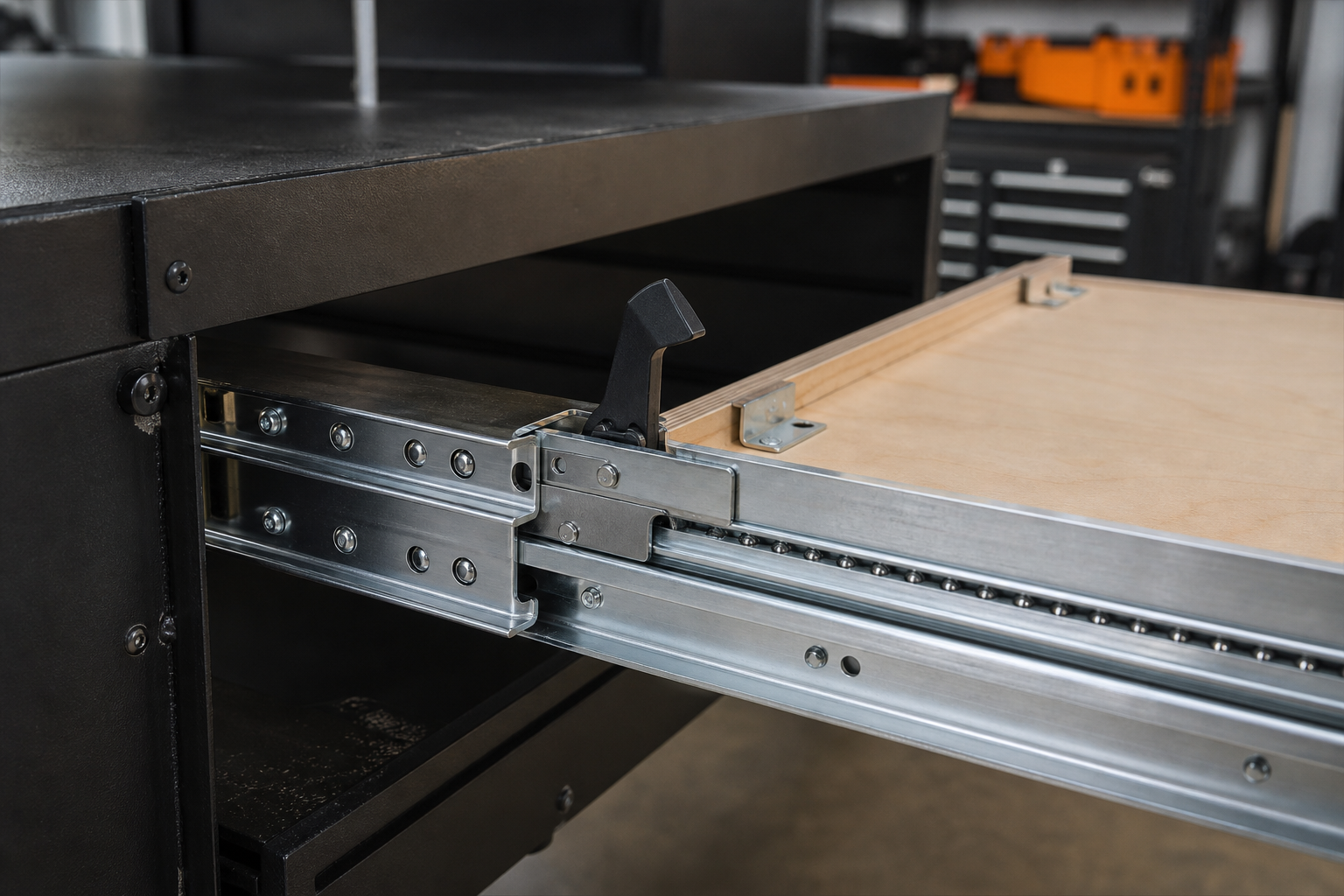
Yes—when the model is specified as lock-in and lock-out. Lock-in holds the drawer closed; lock-out holds it fully extended. A slide described only as “locking” may provide one position rather than both, so verify the exact model before ordering.
- Published by
- COREAX
- Technical review
- COREAX Product Support
- Published
- Updated
Direct answer
Two end positions, not unlimited stops
Lock-in secures the drawer in its fully closed position. Lock-out secures it at full extension until the release is operated. These terms describe end-position control; they do not mean the slide locks at every halfway point.
Operating sequence
What happens from closed to open
- ClosedLock-in engaged
The closed-position latch resists unintended opening during storage or transit.
- ReleaseOperate the lever
Keep the release reachable after adding the drawer front, tray, cargo, and trim.
- ExtendedLock-out engaged
At full extension, the open-position latch holds the drawer until it is deliberately released.
Buying checks
Confirm these four details
Evidence note
What this answer is based on
Terminology verifiedAccuride describes its 9308E as a lock-in and lock-out model that secures drawers in open and closed positions; its technical catalog separately lists lock-out-only and lock-in/lock-out variants. This supports the terminology used here, but it does not prove that every product marketed as a locking slide behaves the same way.
- Accuride 9300 Series product documentationManufacturer definition of lock-in and lock-out behavior.
- Accuride drawer slide catalogModel distinctions, side space, mobile-load conditions, and safety limitations.
Evidence boundary: This page is a fit explanation, not a COREAX laboratory test report. Use the applicable COREAX product specification for the purchased size and test the completed installation under its intended load before service.
Fit decision
When both locks are useful
Dual end-position control is most useful when a drawer could move during transit or when an open tray needs to remain stable on uneven ground. Common examples include truck bed drawers, RV fridge trays, trailer storage, generator trays, mobile tool storage, and service-vehicle compartments.
A stationary cabinet may not need mechanical lock-in and lock-out. A normal full-extension slide plus a separate latch can be simpler when only closed-position restraint is required.
COREAX product path
Choose the release architecture after confirming lock-in and lock-out.
For either family, verify closed depth, side clearance, gross moving load, mounting structure, lever travel, and the intended stationary or mobile use before building the drawer. A separate external latch or restraint may still be appropriate when the vehicle, cargo, or application requires it.
Common questions
Locking slide FAQ
Do locking drawer slides lock halfway?
Usually not. Lock-in and lock-out normally refer to the fully closed and fully extended positions. If an intermediate lock is required, choose a model that explicitly provides it or add a separate positioning method.
Is lock-out the same as full extension?
No. Full extension describes travel; lock-out describes a latch that holds the slide at its open end position. A full-extension slide can be non-locking.
Do truck drawers always need locking slides?
No. They need reliable restraint appropriate to the vehicle and installation. Dual-locking slides are one solution; a non-locking slide with a correctly engineered external latch may also control the closed position.
Can a locked-open drawer support a person?
No. Lock-out is not permission to use a drawer or tray as a seat, step, or human-support platform. Follow the product limitations and test only within the intended application.
Consolidated the former glossary and duplicate guide, retained the verified lock-in/lock-out terminology, and added a product-path comparison between COREAX LD2053 single-side release and L2576 linkage-ready locking slides.
Move to the next decision.
Use the next guide in the same planning path, then verify the exact product before ordering.