
Drawer Slide Load Planning
How to choose drawer slide load rating.
Add the complete moving assembly—drawer, tray, face, permanent hardware, equipment, and maximum cargo—then choose an exact slide model whose published pair rating exceeds that working load under the intended orientation, drawer width, length, and stationary or mobile conditions.
- Published by
- COREAX
- Technical review
- COREAX Product Support
- Published
- Updated
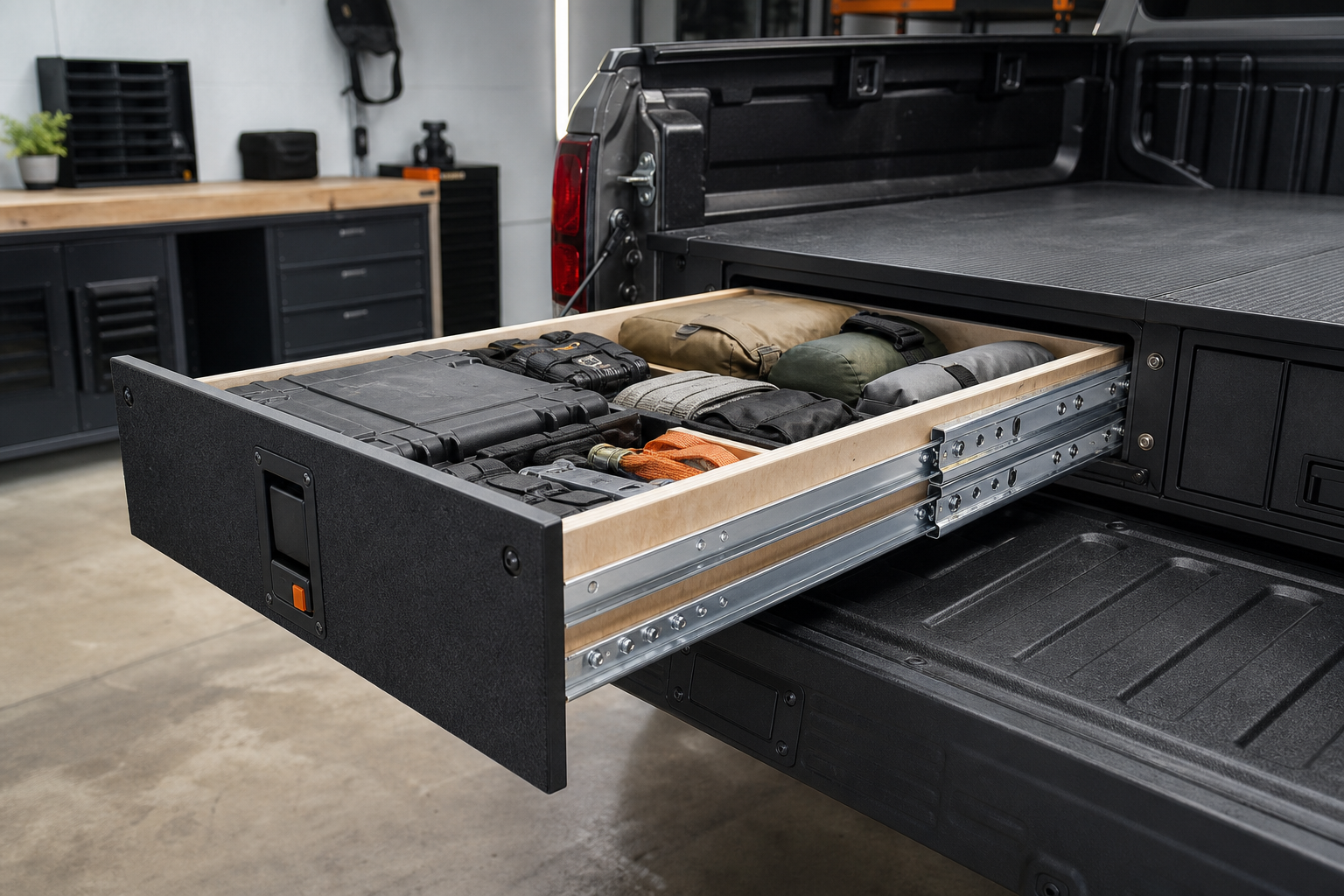
Direct answer
Calculate gross moving weight, then verify the rating conditions.
Do not choose by the cargo weight alone and do not apply an invented universal safety multiplier. Start with the full working load, then compare it with the exact model and size under the mounting orientation and use conditions stated for that product. Vehicle drawers require special attention because a stationary furniture rating may not represent vibration, road shock, slopes, changing load position, or added restraint requirements.
Working-load worksheet
Count everything the pair of slides moves.
Use the heaviest realistic operating condition, not the empty drawer or an average day.
Rating conditions
A capacity number is incomplete without these six checks.
- 01Pair or single rail
Confirm whether the published value applies to a pair. COREAX retail slide ratings on the referenced product pages are pair ratings.
- 02Gross moving weight
Include the drawer construction and contents. A 70 lb fridge on a 30 lb tray is already a 100 lb working load before wiring, brackets, or cargo.
- 03Mounting orientation
Use a side-mount slide vertically unless the exact product documentation approves another orientation and publishes the applicable rating.
- 04Length and drawer width
Longer slides and wider drawers can change capacity, deflection, and torsional demand. Use the selected size, not the family headline alone.
- 05Stationary or mobile use
Truck, RV, trailer, van, and service-vehicle installations add vibration, acceleration, braking, slopes, and restraint requirements.
- 06Supporting structure
The frame, drawer box, fasteners, and mounting faces must remain rigid and parallel at full extension under real load.
Current COREAX product data
Length and product architecture change the published rating.
| COREAX family | Published pair rating | Lengths | Primary fit |
|---|---|---|---|
| LD2053 single-side release | Up to 265 lb; confirm selected variation | 12–40 in | Wide truck, camper, fridge, generator, and utility pull-outs where integrated one-side release matters. |
| L2576 76 mm locking slides | 476 lb at 20–24 in; 379 lb at 40 in; 291 lb at 60 in | 20–60 in | Large mobile and equipment pull-outs with standard lock levers or a builder-supplied release linkage. |
| Black bottom-mount slides | Up to 88 lb | 10–20 in | Bottom-supported cabinet shelves and compact interior pull-outs; not the same structural use as heavy-duty side-mount rails. |
The L2576 examples show why “up to 500 lb” is not a usable selection rule by itself: the current published pair rating decreases as length increases. Use the complete size table on the product page for the selected variation.
Worked example
A 145 lb truck drawer is not a 100 lb slide application.
Why slides bind below the headline rating
The rail may not be the first component failing.
Evidence note
Published ratings come from defined test arrangements.
Manufacturer evidenceAccuride states that its load rating is gross weight including the drawer construction and contents, and describes dynamic cycle testing with an evenly distributed load. Its 9300 product documentation also publishes different stationary and mobile capacities for the same family. These examples show why rating conditions must travel with the number.
- Accuride: How load rating is determinedOfficial explanation of gross moving weight, dynamic cycle testing, evenly distributed load, static testing, and slam testing.
- Accuride 9300 Series product documentationOfficial example publishing separate stationary and mobile capacities and lock-in/lock-out variants.
Evidence boundary: The Accuride test descriptions and capacities apply only to the cited Accuride products. COREAX values on this page come from the current COREAX catalog and product size tables. COREAX has not presented the cited third-party tests as proof of equivalent COREAX test conditions.
COREAX product path
Choose by release, length, and verified working load together.
Start with LD2053 when the pull-out is 12–40 in and an integrated single-side release is central to the design. Use L2576 for 20–60 in large pull-outs where the size-specific load table and customizable linkage-ready lever fit the project. Send the drawer width, selected length, gross moving weight, mounting structure, and vehicle or stationary use when asking for fit guidance.
Common questions
Drawer slide load-rating FAQ
Does drawer slide load rating include the drawer box?
Plan on the complete moving weight: drawer or tray, face, handles, dividers, permanent hardware, mounted equipment, and maximum contents. Confirm the exact manufacturer’s definition for the selected model.
Should I add a 20% or 30% safety factor?
There is no universal multiplier that replaces the exact slide conditions. Choose capacity above the calculated working load, then verify orientation, length, drawer width, mobile use, structure, fasteners, and any manufacturer-specific design margin.
Why does load rating decrease on longer slides?
Length changes the lever arm, deflection, member geometry, and application conditions. The current COREAX L2576 table, for example, publishes lower pair ratings as nominal length increases.
Can a slide bind below its published load rating?
Yes. Tight clearance, frame flex, drawer sag, screw interference, wrong orientation, forward-heavy cargo, or mobile shock can cause binding even when the calculated weight is below the headline number.
Consolidated the former short-answer and glossary pages, added a gross-load worksheet, rating-condition sequence, current COREAX size examples, worked calculation, failure modes, manufacturer sources, and an explicit evidence boundary.
Move to the next decision.
Use the next guide in the same planning path, then verify the exact product before ordering.