
Drawer Slide Travel Terminology
What are full-extension drawer slides?
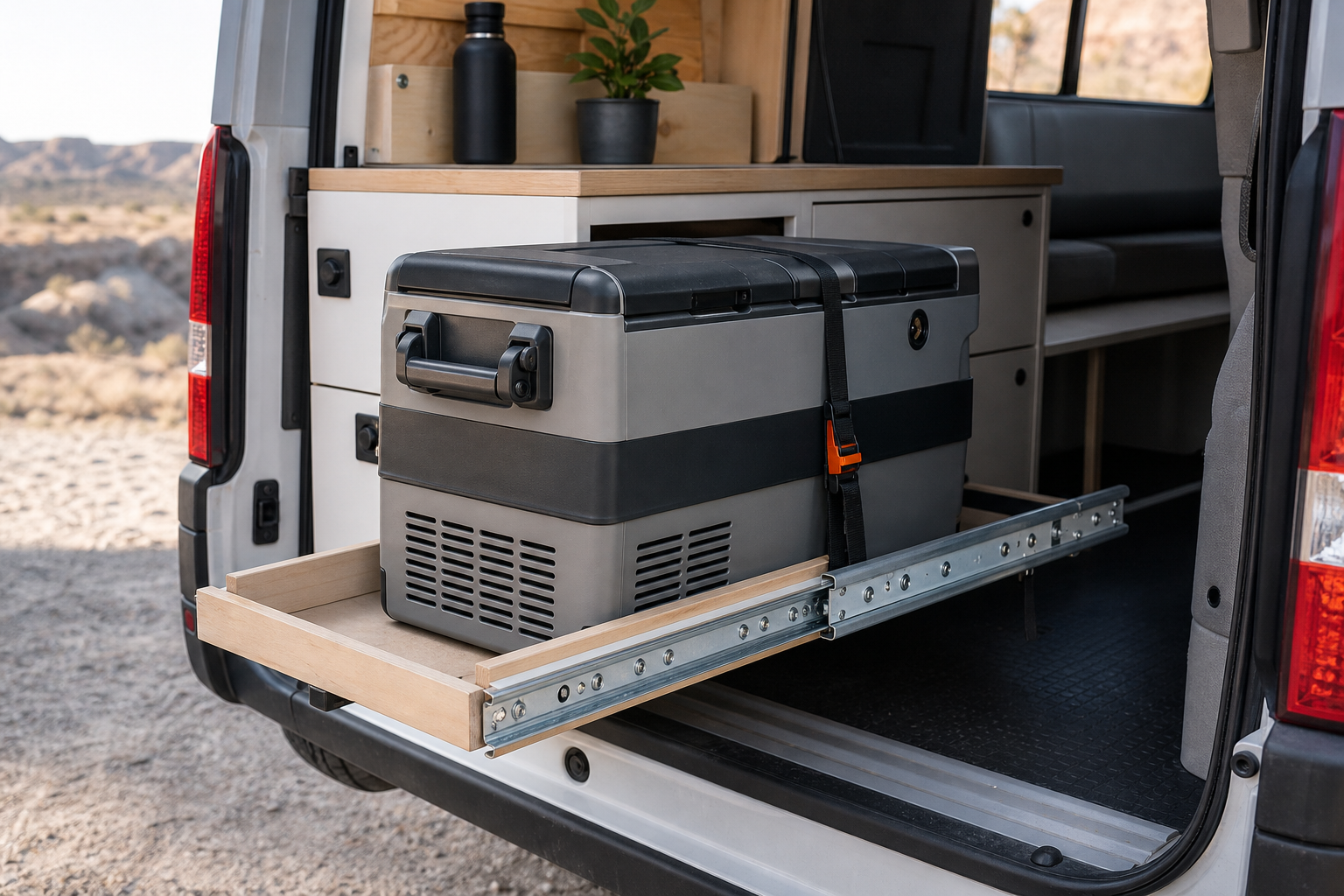
Full-extension drawer slides are designed to move the drawer approximately the closed slide length so the rear of the drawer can come out to the cabinet opening. Full extension describes travel only; it does not automatically mean over-travel, lock-out, vehicle suitability, or complete clearance past a door, countertop, tailgate, or appliance lid.
- Published by
- COREAX
- Technical review
- COREAX Product Support
- Published
- Updated
Direct answer
Full extension means travel approximately equals the closed slide length.
For a nominal 20-inch full-extension slide, the moving member typically travels approximately 20 inches from the closed position, subject to the exact product drawing and tolerances. That can bring a drawer’s rear area close to the front plane of the cabinet. It does not promise that the drawer clears a face frame, countertop, bumper, tailgate, or door that projects in front of the opening.
The correct purchase question is therefore not only “is it full extension?” but “how much actual travel does this size provide, and does that travel place the working area where I need it?”
Travel types
Partial extension, full extension, and over-travel solve different access problems.
| Travel type | Typical relationship | What the user can access | Common reason to choose it |
|---|---|---|---|
| Partial extension | Travel is less than closed slide length | Front and middle of the drawer; rear remains partly covered | Compact hardware, light-duty drawers, limited opening need |
| Full extension | Travel is approximately the closed slide length | Most or all of the drawer length reaches the opening plane | Tools, truck drawers, pantry trays, fridge access, deep cabinets |
| Over-travel | Travel exceeds closed slide length | Drawer moves beyond the opening plane | Clearing countertops, doors, face frames, or service panels |
| Two-way travel | Movement occurs in both directions from a center position | Access from either side of a cart, island, or pass-through cabinet | Shared workstations and two-sided access |
Terms that are not interchangeable
Travel, lock behavior, and drawer removal are separate features.
Usable access
Calculate where the tray must end, not just how far the rail moves.
For a cabinet drawer, full extension often provides adequate rear access. For an appliance tray or vehicle drawer, the tray may need to clear a projecting obstruction before the lid, service panel, or work surface can be used. Measure from the slide’s closed position to the required working position and compare that distance with the exact published travel.
Examples of obstructions include a face frame, cabinet door, tailgate, hatch seal, bumper, countertop overhang, fridge lid, stove windscreen, or drawer handle. If the required travel is greater than the selected full-extension travel, consider an over-travel system or redesign the enclosure rather than assuming “full extension” will solve the interference.
COREAX model examples
All current COREAX slide families use travel differently.
Application checks
Full extension creates access and additional leverage.
As the drawer reaches full extension, the moving load is carried farther from the cabinet. The frame, drawer box, fasteners, rail alignment, and load distribution therefore become more visible in operation. A drawer that moves smoothly halfway can sag or bind near full extension because that is where frame flex and front-heavy loading are most demanding.
- Confirm the complete moving weight, including the drawer or tray.
- Keep both mounting faces parallel through the entire rail length.
- Check the drawer face, handle, and lock lever at the closed and open positions.
- Cycle the empty drawer before adding load, then increase load gradually.
- Observe front-edge drop and frame movement at full extension.
- For vehicles, verify closed restraint and cargo restraint separately from travel.
- For appliances, allow cable, hose, ventilation, lid, and service-panel movement.
Common mistakes
Why a “full-extension” purchase can still provide poor access.
Evidence and terminology
Manufacturers publish travel as a defined feature.
Manufacturer sourcesAccuride describes its 9300 Series as a three-member full-extension design and separately identifies lock-in/lock-out variants. Its 301-2590 platform slide publishes 0.83 inch of over-travel, demonstrating that extension beyond the nominal opening is an additional specified amount rather than an automatic result of full extension.
- Accuride 9300 SeriesOfficial full-extension examples with lock variants listed as separate features.
- Accuride 301-2590Official platform slide example with a specified 0.83-inch over-travel amount and top/bottom mounting brackets.
Evidence boundary: The cited travel and ratings apply only to the named Accuride products. COREAX travel statements come from current product data and size tables. Measure the selected product and completed enclosure before treating nominal length as guaranteed usable access.
Next step
Choose travel after measuring the required working position.
Use Drawer Slide Length vs Drawer Depth to select the longest closed slide that fits. Then use the exact travel value to confirm access. For trays that must remain stable at full extension, continue to Lock-In and Lock-Out Drawer Slides.
Common questions
Full-extension FAQ
Are full-extension slides the same length when open and closed?
No. The closed slide has nested members. At full extension, the assembly becomes much longer because the members telescope. Use the model drawing for closed length, travel, and total extended length.
Does full extension mean the drawer comes completely outside the cabinet?
It usually brings the drawer length approximately to the opening plane, but face frames, doors, countertops, and other obstructions can still cover part of the drawer. Over-travel may be needed for clearance beyond the opening.
Do full-extension slides automatically lock open?
No. Full extension describes travel. Lock-out is a separate latch feature that must be specified for the exact model.
Is more extension always better?
No. More travel can increase required space, leverage, frame demand, and cost. Choose the travel needed for access and service rather than the largest available value.
Expanded the definition into a travel comparison, obstruction worksheet, COREAX model examples, leverage and application checks, manufacturer sources, and four-question FAQ.
Move to the next decision.
Use the next guide in the same planning path, then verify the exact product before ordering.