
Heavy-Duty Drawer Slide Selection Guide
How to choose heavy-duty drawer slides.
Choose the slide only after defining the complete moving load, closed depth, drawer width, side space, full-travel path, stationary or mobile use, required lock positions, release access, mounting structure, and fasteners. A large capacity headline cannot correct the wrong length, orientation, frame, or release design.
- Published by
- COREAX
- Technical review
- COREAX Product Support
- Published
- Updated
Direct answer
Use nine filters in order.
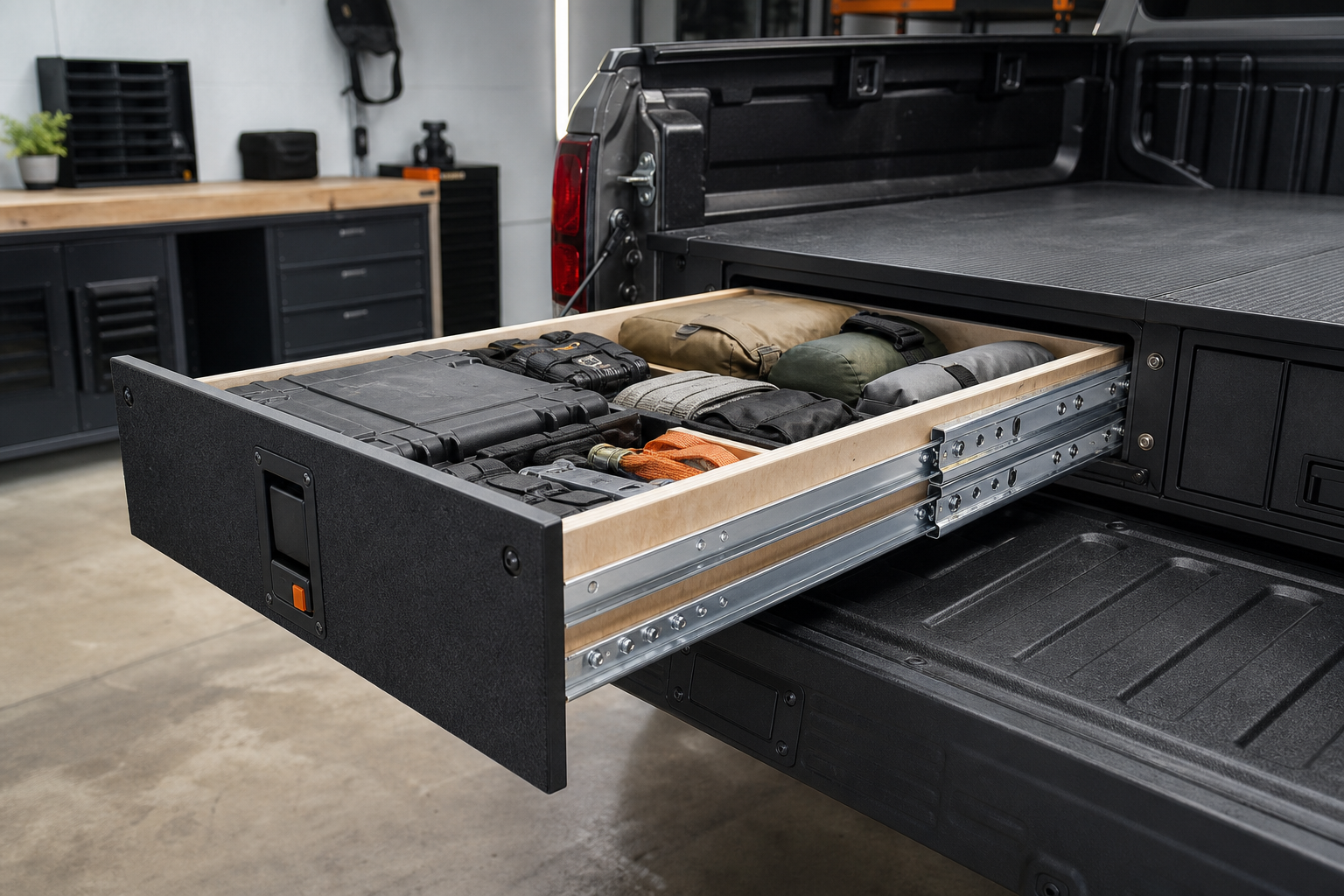
Start with the build, not the product listing. Measure the usable closed rail path and opening width. Calculate the complete moving weight. Decide whether the application is stationary or moves with a vehicle. Define full-extension or over-travel access, lock-in and lock-out requirements, release method, mounting orientation, frame material, and service access. Only then compare slide families and sizes.
For current COREAX products, LD2053 is the integrated single-side-release route for 12–40 inch pull-outs up to the applicable 265 lb family specification. L2576 is the larger 76 mm, 20–60 inch, linkage-ready route with size-specific published pair ratings from 476 lb down to 291 lb. They are not interchangeable versions of the same installation.
Decision path
Nine filters that prevent the most expensive rebuilds.
- 01Define the moving assembly
List the drawer or tray, face panel, handles, locks, dividers, fixed equipment, and maximum realistic cargo. Do not count only what you plan to store.
- 02Measure the usable closed depth
Measure at rail height on both sides and subtract rear obstructions, trim, fasteners, wiring, and service space. Use the shorter side.
- 03Measure the opening and side space
Take front, middle, and rear widths. Use the narrowest value and subtract the actual thickness of both rails before sizing the drawer.
- 04Classify stationary or mobile use
A workshop cabinet and a truck drawer can carry the same static weight but experience different vibration, shock, restraint, and frame demands.
- 05Define required travel
Full extension may expose the drawer to the opening plane; over-travel may be needed to clear a tailgate, face frame, countertop, or appliance lid.
- 06Define position control
Choose closed restraint, open restraint, both end positions, a separate latch, or an intermediate stop. Do not treat soft-close or a detent as a positive lock.
- 07Choose the release architecture
Integrated single-side release, two independent levers, or a builder-supplied linkage have different access, fabrication, and maintenance requirements.
- 08Design the mounting structure
Both vertical faces must stay parallel and stiff at full extension. Select fasteners for plywood, solid wood, steel, aluminum, or threaded inserts.
- 09Test the completed system
Cycle empty, tighten in stages, increase load gradually, inspect frame movement and screw interference, and verify locks before service or travel.
Load workbook
Calculate what the rail pair actually moves.
Do not apply an invented universal safety multiplier. Instead, verify the exact model’s length, width, orientation, load distribution, cycle basis, stationary/mobile condition, and installation structure. If documentation does not cover the application, obtain technical guidance or use a system with a clearly applicable rating.
Front-heavy loading deserves separate attention. Two drawers with the same total weight can behave differently when one stores dense items near the cabinet and the other places a battery, cooler, or tool chest at the front edge.
Measurement sheet
Record dimensions before choosing a nominal length.
| Measurement | Where to measure | How it changes selection |
|---|---|---|
| Usable rail depth | At left and right mounting faces, at rail height | Sets the maximum closed slide length |
| Opening width | Front, middle, and rear | Sets maximum drawer width after both rail thicknesses |
| Vertical rail envelope | Full profile plus lever and fastener access | Determines whether the frame and drawer side are tall enough |
| Required open position | Past tailgate, door, countertop, hatch, or trim | Determines full-extension versus over-travel need |
| Release hand space | With drawer face, cargo, and trim installed | Determines integrated, dual-lever, or linked release |
| Service-removal path | Drawer fully open and surrounding equipment in place | Determines disconnect and maintenance plan |
Use Drawer Slide Length vs Drawer Depth for the closed-length calculator and Drawer Slide Side Clearance for the width formula.
Stationary vs mobile
Vehicle use is not a minor variation of cabinet use.
A stationary test generally applies load in a controlled fixture. A vehicle drawer also experiences vibration, braking, cornering, road shock, chassis flex, slopes, changing cargo distribution, dust, moisture, and repeated lock engagement. The slide, frame, fasteners, latches, cargo restraint, and enclosure must work together.
Lock and release
Choose how the drawer will be operated after it is loaded.
Lock-in and lock-out normally control the fully closed and fully extended positions. Most systems do not lock at every intermediate point. If only closed travel restraint is needed, a non-locking slide plus a suitable external latch can be simpler. If the tray must remain open on uneven ground, lock-out becomes more valuable.
Wide drawers create a release problem. Reaching both side levers can be awkward or impossible after the drawer face and cargo are installed. LD2053 uses an integrated single-side release. L2576 provides linkage-ready L-shaped levers so the builder can connect both sides. The linkage is part of the operating mechanism and must be designed, aligned, and tested rather than treated as decorative hardware.
Continue to Single-Side Release Drawer Slides and Locking Slide End Positions.
Current COREAX families
LD2053 and L2576 solve different heavy-duty projects.
| Feature | LD2053 | L2576 |
|---|---|---|
| Nominal sizes | 12–40 in | 20–60 in |
| Profile | About 53 mm high × 19 mm thick | 76 mm high × about 19 mm thick |
| Side space | About 19 mm per rail | About 19 mm per rail |
| Travel | Full extension | Full extension |
| Lock behavior | Lock-in and lock-out | Lock-in and lock-out |
| Release | Integrated single-side release | Standard paired levers or builder-supplied linkage |
| Published capacity | Up to 265 lb family headline; verify selected variation | 476 lb at 20–24 in, decreasing by size to 291 lb at 60 in |
| Best fit | Wide truck drawers, fridge trays, camper and utility pull-outs needing ready one-side operation | Longer, larger, higher-rated custom frames with a planned linkage and substantial side structure |
Do not choose L2576 only because the family maximum is larger. It consumes more vertical space and moves the linkage design into the project. Do not choose LD2053 only because one-side release is convenient if the selected length and rating do not fit the load.
Structure and fasteners
The rail pair is not the complete load path.
The drawer transfers load into the inner members. Bearings and slide members transfer it to the outer rails. Fasteners transfer it into the frame. The frame transfers it into the vehicle, cabinet, cart, or equipment structure. Any weak or flexible connection can cause binding, sag, noise, loose locks, or failure below the slide headline.
- Use straight, stiff mounting faces that remain parallel under extension.
- Match fastener material, diameter, head profile, embedment, and spacing to the substrate.
- Keep screw or bolt heads outside the moving-member envelope.
- Use threaded inserts, through-bolts, rivet nuts, or backing plates when the structure requires them.
- Do not rely on thin paneling or unsupported drywall as a structural mounting surface.
- Inspect fastener movement and rail alignment after initial loaded cycling.
See What Screws to Use for Heavy-Duty Drawer Slides for the material-specific matrix.
Selection errors
What usually forces a drawer rebuild.
Evidence hierarchy
Use the strongest available evidence for each claim.
Manufacturer sourcesAccuride describes load-rating tests using mounted fixtures, distributed loads, cycle testing, deflection measurements, static full-extension tests, and impact tests. Its 9300 product family separately publishes stationary/mobile capacities, full extension, drawer-width limits, and lock variants. These examples show why a capacity number must remain attached to its conditions.
- Accuride Load Rating Test OverviewManufacturer description of fixture, distributed load, cycle, deflection, static full-extension, and impact testing.
- Accuride 9300 SeriesOfficial example of separate stationary/mobile ratings, full-extension travel, dimensions, and lock variants.
Evidence boundary: Accuride data applies only to the named products. COREAX specifications come from current catalog and product data. This guide does not claim third-party certification, a universal mobile rating, or laboratory validation for every custom installation. Test the completed system under intended conditions.
COREAX product path
Take the completed worksheet to the product page.
Choose LD2053 when the size, working load, approximately 19 mm per-side clearance, and integrated one-side release fit the project. Choose L2576 when its larger profile, size-specific rating, and builder-linked release are justified. If the project is a lighter bottom-supported cabinet shelf rather than a heavy side-framed drawer, compare COREAX bottom-mount slides instead.
Common questions
Heavy-duty slide selection FAQ
What size heavy-duty drawer slide should I choose?
Choose the longest closed length that fits the measured rail path without rear interference, then verify the exact travel, selected-size rating, side clearance, and release access. Do not simply match the drawer depth.
Should I choose a slide rated exactly at my expected load?
No. First confirm whether your calculation includes the complete moving assembly and whether the rating applies to the selected length, width, orientation, and stationary/mobile use. Use applicable documented conditions rather than an invented universal multiplier.
Which COREAX heavy-duty slide is easier for one-hand release?
LD2053 provides an integrated single-side release. L2576 provides linkage-ready levers, but the builder must supply, fit, and validate the linkage that releases both sides.
Can a high-capacity slide fix a flexible truck-drawer frame?
No. Flexible mounting faces can move out of parallel and cause binding or uneven lock engagement below the slide rating. Frame stiffness and fasteners are part of the system.
Expanded with a nine-filter workflow, load and measurement worksheets, stationary and mobile-use checks, current LD2053/L2576 comparisons, structural checks, and four common selection questions.
Move to the next decision.
Use the next guide in the same planning path, then verify the exact product before ordering.