
Folding Bracket Count And Spacing
Folding bracket spacing guide.
Choose bracket count and spacing from shelf length, board stiffness, shelf depth, end overhang, concentrated load zones, wall-backing locations, bracket alignment, and release access. There is no single spacing number that works for every wood species, plywood thickness, workbench, laundry shelf, RV table, or wall.
- Published by
- COREAX
- Technical review
- COREAX Product Support
- Published
- Updated
Direct answer
Start with two end brackets, then add support when span, load, or backing requires it.
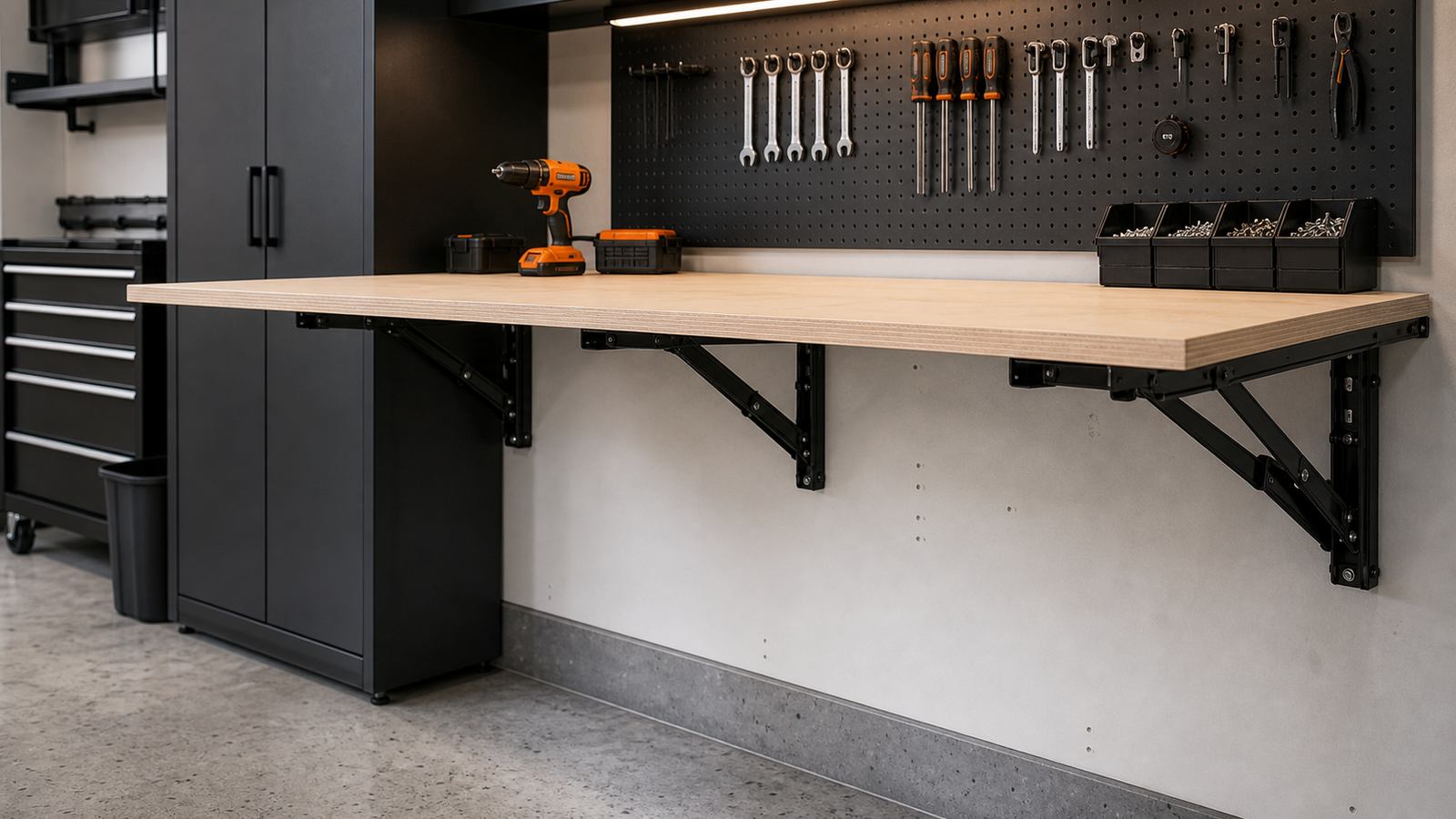
Place end brackets far enough inward to control shelf-end overhang while remaining attached to adequate structure. Measure the clear span between those supports. Add one or more intermediate brackets when the shelf board would deflect excessively, the shelf is long or deep, a concentrated load sits between supports, the surface receives front-edge work, or structural backing creates a better support layout.
Do not calculate bracket count by dividing the bracket-pair load rating into the expected weight. Spacing is primarily a shelf-board and load-distribution decision, while every bracket also needs a valid wall connection and aligned open position.
Spacing worksheet
Record five dimensions and three load conditions.
| Input | Record | Why it matters |
|---|---|---|
| Total shelf length | _____ in | Sets total support line and potential number of spans |
| Shelf depth | _____ in | Changes front-edge leverage and board bending |
| Board material and thickness | _____ | Controls stiffness, fastener behavior, and moisture sensitivity |
| Left end overhang | _____ in | Unsupported cantilever beyond first bracket |
| Right end overhang | _____ in | Unsupported cantilever beyond last bracket |
| Uniform stored load | _____ lb | Distributed demand across shelf and brackets |
| Concentrated loads | Location + weight | May require a bracket below or beside the load zone |
| Front-edge work or impact | Yes / No | Increases demand beyond passive storage |
| Structural backing positions | Mark on wall plan | Limits where brackets can transfer load safely |
Bracket-count logic
Use the board spans, not the shelf length alone.
Two brackets create one main span plus two end overhangs. Three brackets create two main spans. Four brackets create three. Reducing span generally reduces board deflection, but only if each bracket contacts the shelf and carries load. A middle bracket mounted too low contributes little until the shelf bends down to meet it; a bracket mounted too high can carry the shelf before the end brackets.
Planning examples
Use examples to ask better questions, not as universal spacing rules.
| Example surface | Likely starting layout | What can change it |
|---|---|---|
| 30 in × 12 in compact shelf | Two brackets near suitable backing with modest end overhang | Thin board, dense appliance, poor backing, front-heavy use |
| 48 in × 16 in laundry surface | Two or three brackets depending on board stiffness and stud/backing locations | Detergent containers, wet laundry, sink/appliance gaps, repeated leaning |
| 72 in × 16 in garage workbench | Three or more supports or a framed top, subject to backing and work loads | Vise, tool impacts, clamping, thick top, concentrated machine load |
| 36 in RV table | Two structurally backed brackets plus travel latch | Thin RV wall, table depth, vibration, seating/egress conflicts |
| 60 in outdoor prep shelf | Three supports may reduce span and improve drainage/board control | Stainless/coating choice, wet board, wind, masonry backing, appliance heat |
These are layout prompts, not capacities. The actual board, bracket, fastener, backing, load, and installation still need verification.
Board stiffness
A flexible shelf needs shorter spans or a stronger section.
Board bending increases rapidly as unsupported span grows. Material and thickness matter, but so do depth, grain direction, moisture, edge details, holes, and point loads. A thicker board can reduce deflection; adding a front apron, torsion-box construction, or metal subframe can also increase stiffness, though each changes weight and folded thickness.
Use the shelf-board thickness guide and structural product data rather than selecting spacing by appearance.
Load zones
Place support near fixed or concentrated loads.
A microwave, mixer, vise, printer, water container, battery, or tool chest can create a local demand much greater than evenly distributed items. If the load location is fixed, arrange brackets or a subframe to transfer it efficiently. Avoid placing the heaviest item at the front center of the largest unsupported span.
- Mark every appliance foot or base rail.
- Mark tool-clamping and impact zones.
- Mark containers that can become heavier when filled.
- Place support near the load or provide a stiff distribution member.
- Keep heat-generating appliances within their clearance requirements.
- Do not let a fixed load block bracket release access.
- Recheck travel and folding with the equipment removed or secured.
Backing locations
Ideal spacing is useless if the middle bracket mounts to weak wall finish.
Bracket positions must coincide with adequate studs, blocking, plywood backing, masonry anchor zones, or a designed steel-frame connection. If the desired support location lacks backing, add structural backing or use a properly attached horizontal mounting rail/subframe that distributes load to valid connection points. Do not shift brackets arbitrarily and then assume the shelf board will compensate.
The consolidated stud/drywall guidance is in How to Reinforce a Wall for Folding Shelf Brackets.
End overhang
Control the shelf beyond the outside brackets.
End overhang is a cantilevered section of board. Excessive overhang can deflect or twist when loaded, especially on a thin shelf or when a person presses near the corner. Keep overhang consistent where practical and avoid locating a heavy object outside the outer bracket.
Alignment and release
More brackets require more precise installation.
Every bracket must reach the same open plane so the shelf shares load. Wall waves, mismatched reference marks, different screw tension, shelf warp, or mechanism tolerance can leave one support high or low. Use a continuous straight datum, install loosely, place the shelf, cycle all brackets, shim where appropriate, and tighten in stages.
Multiple brackets also add release operations. Make sure each flat tab can be reached, and establish a safe sequence for lowering the shelf without one bracket remaining locked while the others fold. On long surfaces, a coordinated release design may be needed, but it must not compromise lock engagement.
COREAX bracket family
Pair packaging does not mean every shelf should use exactly two.
COREAX folding brackets are sold as a pair in 8–16 inch sizes and black or stainless paths. The pair provides a normal starting unit for compact shelves. Longer or more flexible surfaces can require additional pairs or a separate subframe. Adding brackets does not linearly multiply finished capacity, because board, wall, fasteners, alignment, and load sharing remain limits.
Use the family claim accurately: the brackets are listed up to 300 lb per pair under applicable product conditions, while the completed shelf capacity depends on the entire load path.
Validation process
Confirm that every bracket is carrying the shelf.
- 01Cycle brackets individually
Confirm each mechanism locks and releases before the shelf is attached.
- 02Set one continuous open plane
Use a straightedge or level across all bracket arms and correct high/low supports.
- 03Attach shelf without forcing it flat
A warped shelf can preload brackets and hide alignment errors.
- 04Load near each support
Observe wall movement, fastener slip, noise, and whether the adjacent brackets remain engaged.
- 05Load span centers and real load zones
Measure or observe deflection and stop if the surface behaves outside the intended use.
- 06Unload and inspect
Check permanent board bend, loose fasteners, wall cracks, mechanism changes, and unequal shelf contact.
Evidence and span boundary
Panel span and fastener capacity require defined inputs.
Technical sourcesWoodWorks describes the bending, rolling-shear, and deflection checks required for wood structural panels acting out of plane. APA span information similarly ties allowable span to panel rating, thickness, support, and load rather than one universal shelf spacing. These sources support using bracket spacing as a board-design decision.
- WoodWorks: Out-of-Plane Wood Structural PanelsTechnical discussion of panel bending, rolling shear, deflection, and applicable adjustment factors.
- APA: Load-Span Tables for Wood Structural PanelsOfficial publication listing for uniform-load tables that distinguish panel construction, support direction, span, and deflection criteria.
Evidence boundary: These sources do not calculate a safe bracket spacing for an unknown custom shelf. The examples on this page are planning prompts. For structural, public-use, human-support, masonry, steel-frame, vehicle, or unusually loaded surfaces, obtain appropriate design and product-specific data.
COREAX fit support
Send the shelf plan and load zones.
Provide shelf length, depth, material, thickness, proposed bracket size, available backing locations, end overhangs, complete load, fixed load positions, front-edge work, indoor/outdoor or vehicle exposure, and photos of the wall. COREAX can help identify product-fit questions but cannot assign structural capacity to an undocumented shelf and wall.
Common questions
Folding bracket spacing FAQ
How far apart should folding shelf brackets be?
There is no universal spacing. Choose it from shelf material and thickness, depth, total length, end overhang, load zones, bracket conditions, and structural backing locations.
How many folding brackets do I need for a long shelf?
Start with end supports and add intermediate brackets until the board spans and concentrated loads are adequately supported at valid wall-backing locations. Long or flexible shelves commonly need more than one pair.
Does adding a third bracket increase capacity by 50 percent?
Not automatically. The middle bracket must have adequate backing, align with the others, and receive load through a stiff enough shelf. The wall, fasteners, board, or bracket can still control capacity.
Should brackets be evenly spaced?
Even spacing is a useful starting layout, but concentrated loads, backing positions, end overhang, and release access can justify different locations. Every span still needs review.
Absorbed the bracket-count topic and rebuilt the canonical spacing page with a measurement worksheet, count logic, planning examples, board stiffness, load zones, backing, end overhang, alignment, validation, technical sources, and FAQ.
Move to the next decision.
Use the next guide in the same planning path, then verify the exact product before ordering.