
Folding Bracket Selection Guide
How to choose folding shelf brackets.
Choose folding brackets by the complete load path: wall structure, fasteners, bracket length, shelf depth, shelf-board stiffness, bracket spacing, load position, release access, finish, folded clearance, travel restraint, and the way the surface will actually be used. The bracket rating alone does not establish finished shelf or workbench capacity.
- Published by
- COREAX
- Technical review
- COREAX Product Support
- Published
- Updated
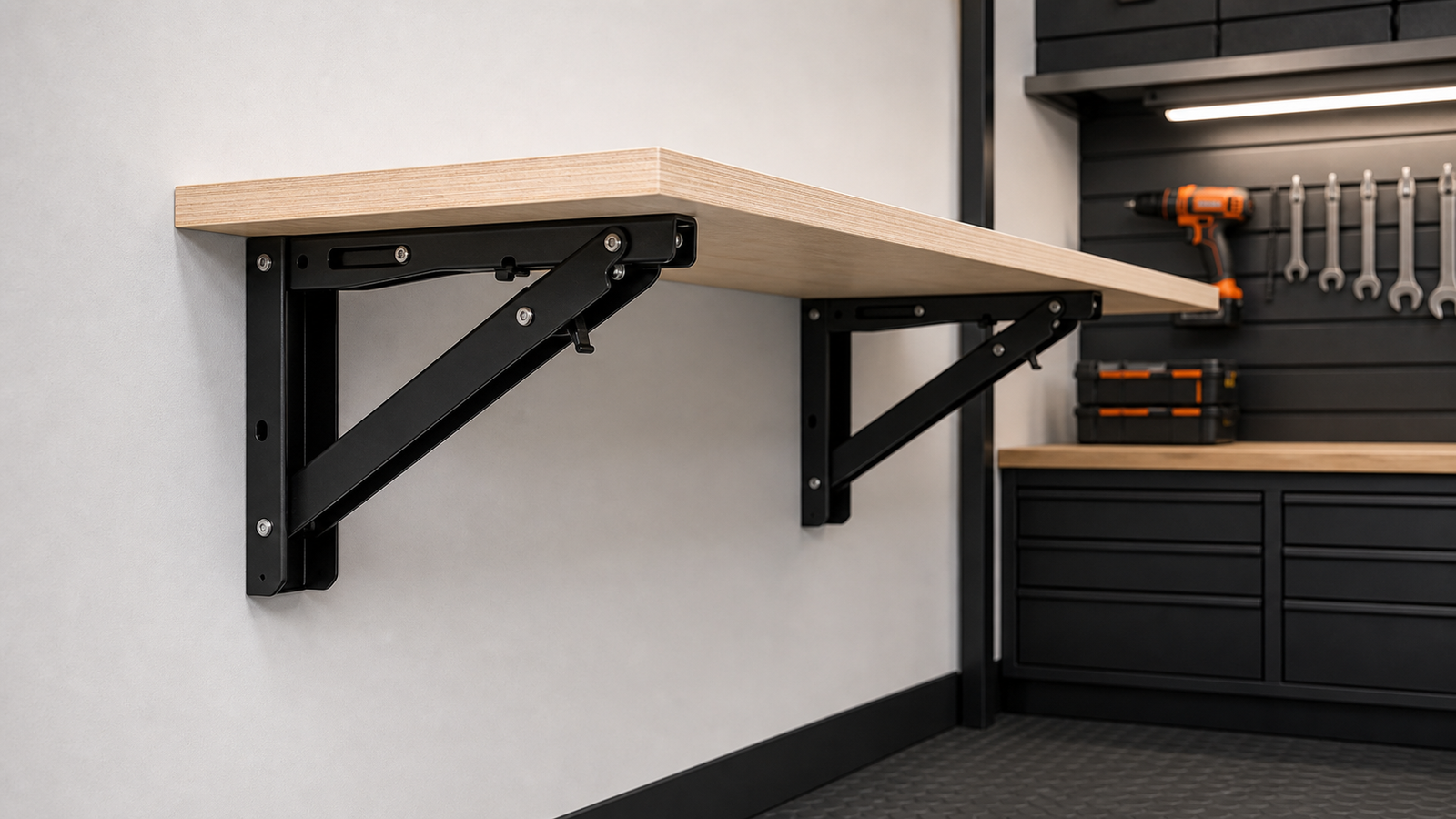
Direct answer
Use eight filters before choosing bracket size.
Define the surface task and complete load. Identify real structural backing. Measure shelf length and depth. Choose bracket projection that supports the shelf without excessive front overhang. Select enough brackets to control the board span. Match fasteners to the wall and shelf materials. Confirm release and folded clearances. Then choose black carbon steel or stainless according to exposure and maintenance.
COREAX folding brackets are offered in 8, 10, 12, 14, and 16 inch sizes with black carbon-steel or stainless options and a family claim of up to 300 lb per pair. That headline belongs to the product family, not every wall, shelf, spacing, fastener, or load position.
Decision path
Eight filters that turn a bracket into a complete system.
- 01Define the surface use
Storage shelf, laundry table, desk, garage workbench, RV table, outdoor prep shelf, or temporary service surface. Human-support uses require purpose-designed engineering.
- 02Calculate the complete load
Include the shelf board, fixed equipment, stored items, tools, containers, and realistic front-edge or impact loads.
- 03Identify structural backing
Locate studs, blocking, plywood backing, masonry, steel framing, or another documented load path. Drywall alone is not a universal structural mounting surface.
- 04Choose bracket projection
Match the bracket arm to shelf depth so the unsupported front overhang remains controlled and the release is reachable.
- 05Choose count and spacing
Use shelf length, board stiffness, load zones, overhang, and available backing locations—not one generic spacing number.
- 06Select fasteners
Match holes, head geometry, substrate, embedment, corrosion exposure, and required clamp area.
- 07Check operation
Confirm level open position, release access, finger clearance, folded thickness, wall/baseboard conflicts, and travel restraint where applicable.
- 08Validate gradually
Cycle both brackets, load near the wall first, increase weight in steps, and inspect fasteners, wall movement, shelf sag, and unequal mechanism engagement.
Use-case matrix
Different surfaces create different dominant risks.
| Application | Primary requirement | Key checks |
|---|---|---|
| Laundry folding shelf | Wide cleanable surface with moderate distributed load | Stud/backing locations, detergent weight, moisture, board stiffness, folded appliance clearance |
| Garage workbench | Impact, tools, clamping, and front-edge work | Structural backing, board thickness, bracket count, load position, surface damage, no human-support assumption |
| RV or camper table | Lightweight surface that folds securely for travel | RV backing, vibration, travel latch, egress, seat/door interference, appliance heat and fuel clearance |
| Kitchen or utility shelf | Frequent deployment and cleanable finish | Cabinet/door clearance, liquids, food or chemical cleaning, wall structure, release comfort |
| Outdoor prep shelf | Moisture, temperature, contamination, and corrosion exposure | Stainless/coating choice, compatible fasteners, drainage, wall material, maintenance |
| Desk or keyboard surface | Level support, knee clearance, repeated light use | Ergonomic height, front deflection, cable clearance, release location, board edge comfort |
Load path
Follow the load from the front edge into the wall.
The shelf carries the objects and spans between brackets. Each bracket transfers force through its horizontal arm, hinge or locking mechanism, and vertical wall plate. Fasteners transfer the force into backing. The backing transfers it into studs, masonry, steel framing, or another structural system. The weakest component or connection controls the finished result.
Continue to Folding Bracket Load Rating vs Real Shelf Capacity for the full system calculation.
Bracket size
Support shelf depth without excessive front overhang.
A deeper shelf moves the load farther from the wall and increases leverage. The bracket does not always need to reach the absolute front edge, but the remaining overhang must be supported by a shelf board stiff enough for the load and use. A short bracket under a deep workbench can create large front deflection even when the total weight is moderate.
| COREAX size | Typical planning range | Questions before selection |
|---|---|---|
| 8 in | Shallow utility shelf or compact side table | Is the board shallow and stiff? Are hands clear of the release? |
| 10 in | Compact shelf, laundry accessory, small desk surface | How much front overhang remains and what load sits there? |
| 12 in | General shelf, pantry/utility surface, compact RV table | Does the wall backing align with the required bracket spacing? |
| 14 in | Deeper table or garage/laundry work surface | Is the shelf board thick and stiff enough between supports? |
| 16 in | Deeper fold-down workbench or prep surface | Can the wall, fasteners, board, and bracket spacing carry the larger lever arm? |
This table is a planning guide, not a capacity chart. Use What Size Folding Bracket Do You Need for Shelf Depth? for a dedicated sizing workflow.
Count and spacing
Bracket count is an output of shelf span and load zones.
Two brackets can support a short stiff shelf and leave a long or flexible shelf sagging between them. Add support where the board needs it and where the wall has adequate backing. Keep end overhangs controlled, and place brackets near concentrated loads rather than assuming every item will remain evenly distributed.
- Measure total shelf length and mark available structural backing.
- Identify fixed loads such as appliances, tool vises, or water containers.
- Choose board material and thickness before final bracket spacing.
- Limit unsupported end overhang.
- Add a bracket or stiffener when the board deflects between supports.
- Do not place a bracket where the release becomes inaccessible.
- Test front-edge and real-use load positions, not only weight near the wall.
Use the folding-bracket spacing worksheet for examples and bracket-count decisions.
Wall and backing
Mount into structure appropriate to the final load.
Drywall, thin RV paneling, decorative wall board, and cabinet skins are finishes rather than universal structural backing. Attach to studs, installed blocking, plywood backing, masonry, steel framing with a tested connection, or another structure designed for the load. The fastener pattern should use the intended bracket holes and keep adequate edge distances.
Continue to How to Reinforce a Wall for Folding Shelf Brackets.
Fasteners
The package hardware cannot cover every wall and shelf.
Choose wall fasteners for the identified substrate and shelf fasteners for the board thickness and material. The heads must seat correctly in the bracket holes without preventing the shelf from folding. Wall and shelf connections may require different fastener types. Use washers or backing only where the bracket geometry permits.
- Confirm the fastener head fits the bracket hole and moving mechanism.
- Use pilot holes where required for wood and splitting control.
- Do not use ordinary drywall screws as structural shelf-bracket fasteners.
- Confirm masonry anchor type, hole cleaning, edge distance, and installation torque.
- Protect dissimilar metals and exposed holes in wet or outdoor applications.
- Use shelf screws short enough not to exit the top surface.
- Inspect and retighten only according to the connection design; recurring loosening indicates movement that needs correction.
Operation and clearance
Test the bracket open, locked, released, and folded.
Black vs stainless
Choose material and finish by exposure, not only color.
Black carbon-steel brackets can suit dry indoor garages, offices, laundry rooms, and RV interiors when the coating remains intact and the appearance fits the build. Stainless brackets are generally the stronger starting point for moisture, frequent cleaning, marine-like exposure, outdoor use, or visible scratches, but stainless grade, fabrication, surface finish, fasteners, and contaminants still affect corrosion.
Use Black vs Stainless Folding Shelf Brackets for the full exposure and maintenance comparison.
COREAX product family
Use the current size and finish range as the starting point.
Selection mistakes
Do not let one product attribute decide the system.
Evidence and structural boundary
Backing and fastening require documented connections.
Technical sourcesSimpson Strong-Tie publishes model-specific fastening data and emphasizes correct fastener quantity, size, placement, material, finish, substrate, and installation. Its WBAC backing connector provides one tested approach for attaching wood backing to cold-formed steel framing, illustrating that backing must itself connect to structure rather than simply sit behind drywall.
- Simpson Strong-Tie Fastening Systems Technical GuideOfficial fastener loads, spacing, substrate, corrosion, and installation information.
- Simpson Strong-Tie WBAC Backing ConnectorOfficial example of a tested connection for wood backing in cold-formed steel walls.
Evidence boundary: These sources do not provide a universal bracket or wall design for every COREAX installation. COREAX product claims come from current catalog data and do not certify the shelf, wall, fasteners, spacing, or completed workbench. Safety-critical, public-use, masonry, steel-frame, vehicle, or human-support installations may require qualified design.
COREAX product path
Send the shelf, wall, and use details before choosing size.
Provide shelf length, depth, thickness, material, complete load, heaviest load position, wall construction and backing, desired bracket locations, indoor/outdoor exposure, folded clearance, and whether the installation moves with a vehicle. Then choose the COREAX folding bracket size and finish that fit the complete system.
Common questions
Folding bracket selection FAQ
What size folding bracket should I use?
Choose a projection that supports the shelf depth with controlled front overhang, then verify load, board stiffness, spacing, wall backing, release access, and folded clearance. Do not size by shelf depth alone.
How many folding brackets does a shelf need?
It depends on shelf length, board stiffness, load zones, end overhang, bracket capacity, and backing locations. Use the spacing guide rather than assuming every shelf needs only two.
Can folding brackets mount to drywall anchors?
Do not assume drywall anchors can carry a work surface or high shelf load. Identify structural backing or use an anchor system specifically designed and documented for the exact wall and load.
Are stainless brackets always better than black brackets?
No. Stainless is generally preferable for moisture and cleaning exposure, while coated black carbon steel can suit dry interiors. The exact material, finish, fasteners, environment, and maintenance determine the choice.
Expanded with an eight-filter workflow, use-case matrix, complete load-path checks, size, spacing, backing and fastener decisions, operation, finish, current COREAX family data, and common questions.
Move to the next decision.
Use the next guide in the same planning path, then verify the exact product before ordering.