
Folding Bracket Capacity Guide
Folding bracket load rating vs real shelf capacity.
A bracket-pair rating describes the hardware under stated conditions. Real shelf capacity is controlled by the complete load path: shelf board, bracket size, bracket spacing, hinge and lock mechanism, wall plate, fasteners, backing, wall frame, shelf depth, load position, repeated use, and installation accuracy.
- Published by
- COREAX
- Technical review
- COREAX Product Support
- Published
- Updated
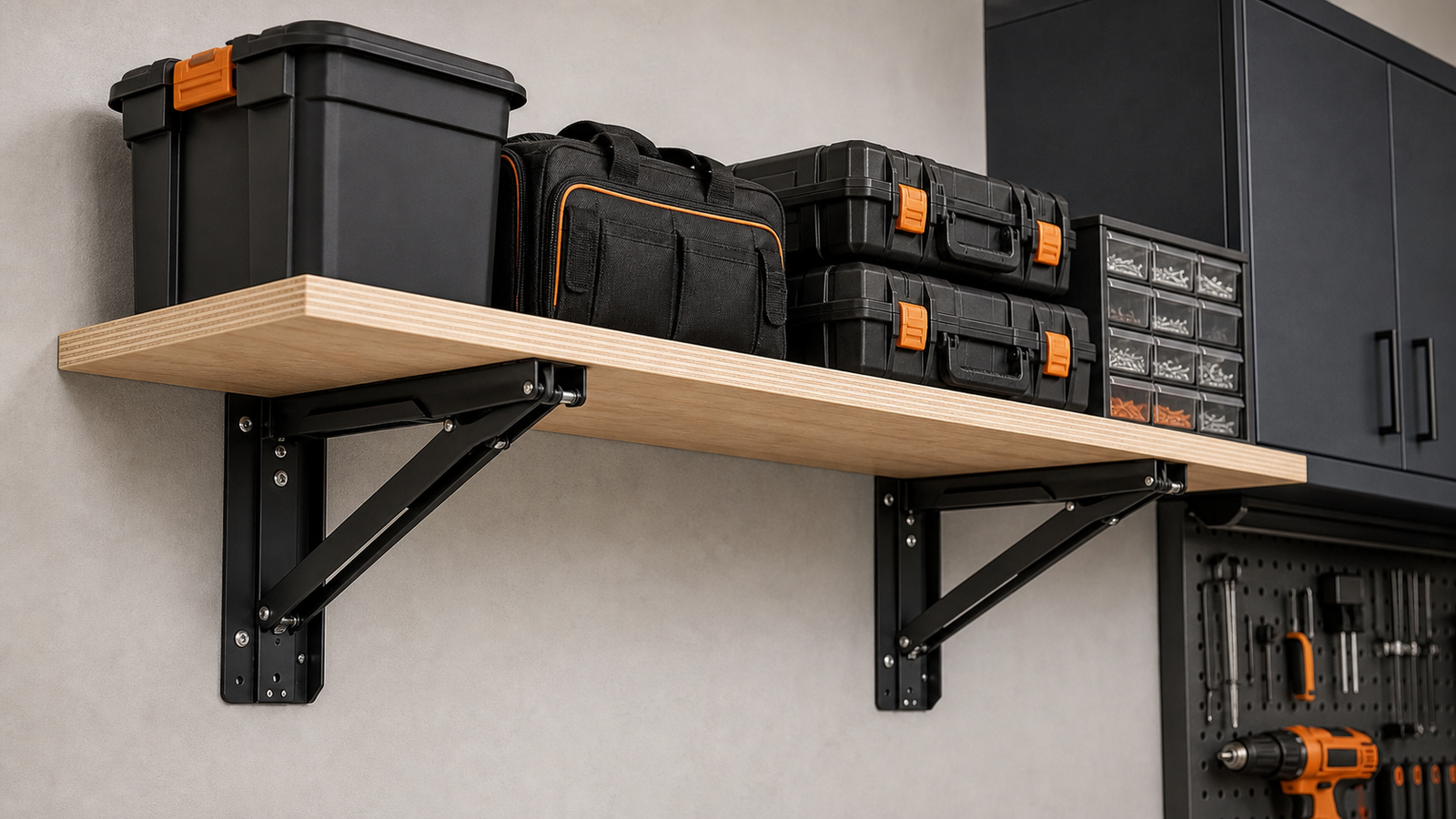
Direct answer
The finished shelf is only as strong as its weakest component and connection.
Do not treat “up to 300 lb per pair” as permission to place 300 lb anywhere on any shelf attached to any wall. First verify the selected bracket pair and size. Then check the shelf board against span and front overhang, use fasteners documented for the wall and board, connect into adequate backing, keep the load position within the intended use, and validate the complete installation gradually.
COREAX’s family claim can be a product-selection input. It is not a finished shelf rating, code approval, human-support rating, or substitute for structural design.
Complete load path
Follow force through seven components.
- 01Load and user interaction
Stored objects, tools, appliance feet, leaning force, impacts, and repeated use enter the shelf at different positions.
- 02Shelf board
The board carries local pressure, spans between brackets, and transfers force into the bracket arms.
- 03Board-to-bracket fasteners
Screws or bolts clamp the shelf to the arms and resist sliding, lifting, splitting, and pull-through.
- 04Bracket arms and mechanism
The horizontal and diagonal members, hinge, lock, and stops carry bending and shear while keeping the shelf open.
- 05Wall plate and wall fasteners
Concentrated forces enter the vertical plate and then the screws, bolts, or anchors.
- 06Backing or masonry
Studs, blocking, plywood, steel framing, concrete, block, or brick receive the connection.
- 07Building or vehicle structure
The backing must transfer the load into the wall frame, masonry assembly, RV frame, cabinet, or another adequate support.
Capacity logic
Real capacity is not calculated by adding bracket ratings.
The practical maximum must be no greater than the capacity of the weakest applicable element under the actual conditions. This is a decision concept, not a numeric engineering formula for an unknown wall.
When any one of these is unknown, the finished shelf capacity is unknown. Do not fill the gap with the bracket headline.
Load position
Moving the same weight forward increases leverage.
A load close to the wall has a shorter lever arm. The same weight at the front edge creates greater moment at the bracket and wall connection. A user leaning on the front edge can create a concentrated, dynamic condition unlike evenly distributed storage.
| Load condition | Effect on system | Planning response |
|---|---|---|
| Evenly distributed storage | Load spreads over the shelf and both brackets | Still verify board span, bracket sharing, and wall connection |
| Heavy item near wall | Shorter lever arm but high local bearing pressure | Support appliance feet and keep weight over/near brackets |
| Heavy item at front edge | Greater wall and bracket moment; more front deflection | Reduce overhang, add support, stiffen board, or redesign use |
| One-side load | One bracket and board region carry more load; shelf can twist | Place brackets near load zone or distribute with a stronger board/frame |
| Impact or tool strike | Short-duration force can exceed normal storage condition | Use a workbench design and backing appropriate to impact, not only shelf storage |
| Human leaning, sitting, or climbing | Dynamic, unpredictable safety-critical load | Do not permit unless the complete surface is purpose-designed and approved for human support |
Shelf board
The board can fail or become unusable before the brackets do.
Board stiffness depends on material, thickness, span, depth, grain direction, construction, moisture, edge treatment, and load placement. Deflection can make a shelf feel weak, cause objects to roll, prevent brackets from sharing load evenly, or loosen fasteners even without sudden failure.
Use Best Wood Thickness for Folding Shelf Brackets for material and fastener considerations.
Bracket count and spacing
More brackets can reduce board span, but only when each bracket is supported.
Adding a center bracket can reduce shelf deflection and help support a concentrated load. It does not automatically multiply capacity if the middle bracket is mounted to weak backing, sits at a different height, or does not contact the shelf equally. Each bracket needs an adequate wall connection and aligned open stop.
- Mark structural backing before choosing bracket locations.
- Keep unsupported end overhang controlled.
- Place support near fixed or concentrated load zones.
- Use a board stiff enough to distribute load to all brackets.
- Install bracket tops in the same plane so one does not carry the shelf first.
- Check release access for every bracket.
- Load-test the real shelf, not an isolated bracket.
The former “how many brackets” page is consolidated into Folding Bracket Spacing Guide.
Wall and fasteners
A strong bracket on weak backing remains a weak installation.
Use the wall reinforcement guide before selecting fasteners.
COREAX claim boundary
“Up to 300 lb per pair” is a hardware-family statement.
COREAX folding brackets are available in 8–16 inch sizes and black carbon-steel or stainless options. The current product family states support up to 300 lb per pair. Use that claim only with the selected variation and suitable installation. Do not publish or repeat it as “this finished shelf holds 300 lb” unless the complete shelf, fasteners, backing, wall, spacing, depth, and load conditions have been validated for that statement.
Installation validation
Load gradually and observe the complete system.
- 01Inspect unloaded geometry
Confirm wall plates sit flat, bracket tops align, shelf is not warped, and mechanisms lock completely.
- 02Cycle repeatedly without load
Check release, folding path, fastener contact, and whether both sides reach the same stop.
- 03Add load near the wall
Watch wall movement, fastener slip, shelf contact, bracket noise, and unequal load sharing.
- 04Move representative load to actual zones
Test the work or storage positions, including the front area only when the design permits it.
- 05Inspect after unloading
Look for permanent shelf deflection, loosened fasteners, cracked finish, wall gaps, bent parts, or changed lock engagement.
- 06Repeat after initial service
Reinspect high-use, vehicle, outdoor, humid, or impact-prone installations.
A field test is useful for finding installation problems. It is not a laboratory certification, proof of long-term fatigue life, or approval for human-support use.
Failure modes
Diagnose the first weak link.
Evidence and design boundary
Panel deflection and fastener capacity require defined conditions.
Technical sourcesWoodWorks explains that wood structural panels used as out-of-plane cantilevers require calculation of bending stress, rolling shear, deflection, and applicable reduction factors. Simpson Strong-Tie’s fastening guide publishes loads and installation conditions by exact fastener and substrate. These sources support treating shelf board and wall connection as independent design checks rather than borrowing the bracket rating.
- WoodWorks: Designing Wood Structural Panels for Out-of-Plane CantileversTechnical discussion of bending, rolling shear, deflection, and adjustment factors for wood structural panels.
- Simpson Strong-Tie Fastening Systems Technical GuideOfficial fastener load, material, spacing, corrosion, and installation information.
Evidence boundary: These sources do not provide a capacity for an unknown COREAX shelf. This guide does not replace structural calculations, code requirements, anchor design, vehicle/RV attachment design, or professional review. COREAX’s bracket-family claim applies only under applicable product conditions.
COREAX fit support
Provide the complete load path for a useful answer.
Send shelf length, depth, material, thickness, bracket size and count, wall construction, backing, proposed fasteners, complete load, heaviest load position, indoor/outdoor or vehicle exposure, and photos of the intended mounting area. COREAX can help identify product-fit questions but cannot assign a structural capacity to an undocumented wall or custom shelf.
Common questions
Folding bracket capacity FAQ
Is bracket load rating the same as finished shelf capacity?
No. Finished capacity also depends on the shelf board, bracket size and spacing, wall plate, fasteners, backing, wall structure, shelf depth, load position, and installation.
Can I multiply the bracket rating by adding more brackets?
Not directly. More brackets can reduce board span, but each bracket needs adequate backing, alignment, and load sharing. The shelf and wall may still control capacity.
Why does a shelf sag below the bracket rating?
The board can deflect between supports, the front overhang can be too large, the wall can move, fasteners can slip, or one bracket can carry more load than the other.
Can I sit or stand on a shelf rated for 300 lb?
No. A storage or bracket-pair rating is not a human-support rating. Seating, steps, sleeping platforms, and similar uses require purpose-designed and appropriately reviewed structure.
Absorbed the bracket-weight-capacity topic and rebuilt the canonical page around the seven-component load path, load position, board, spacing, wall/fastener limits, COREAX claim boundary, validation plan, failure diagnosis, sources, and FAQ.
Move to the next decision.
Use the next guide in the same planning path, then verify the exact product before ordering.