
Folding Shelf Board Guide
Best wood thickness for folding shelf brackets.
The shelf board must be stiff enough to span between folding brackets without sagging. Choose thickness by shelf depth, span, load, fastener length, and whether the surface is for storage, a table, or a workbench.
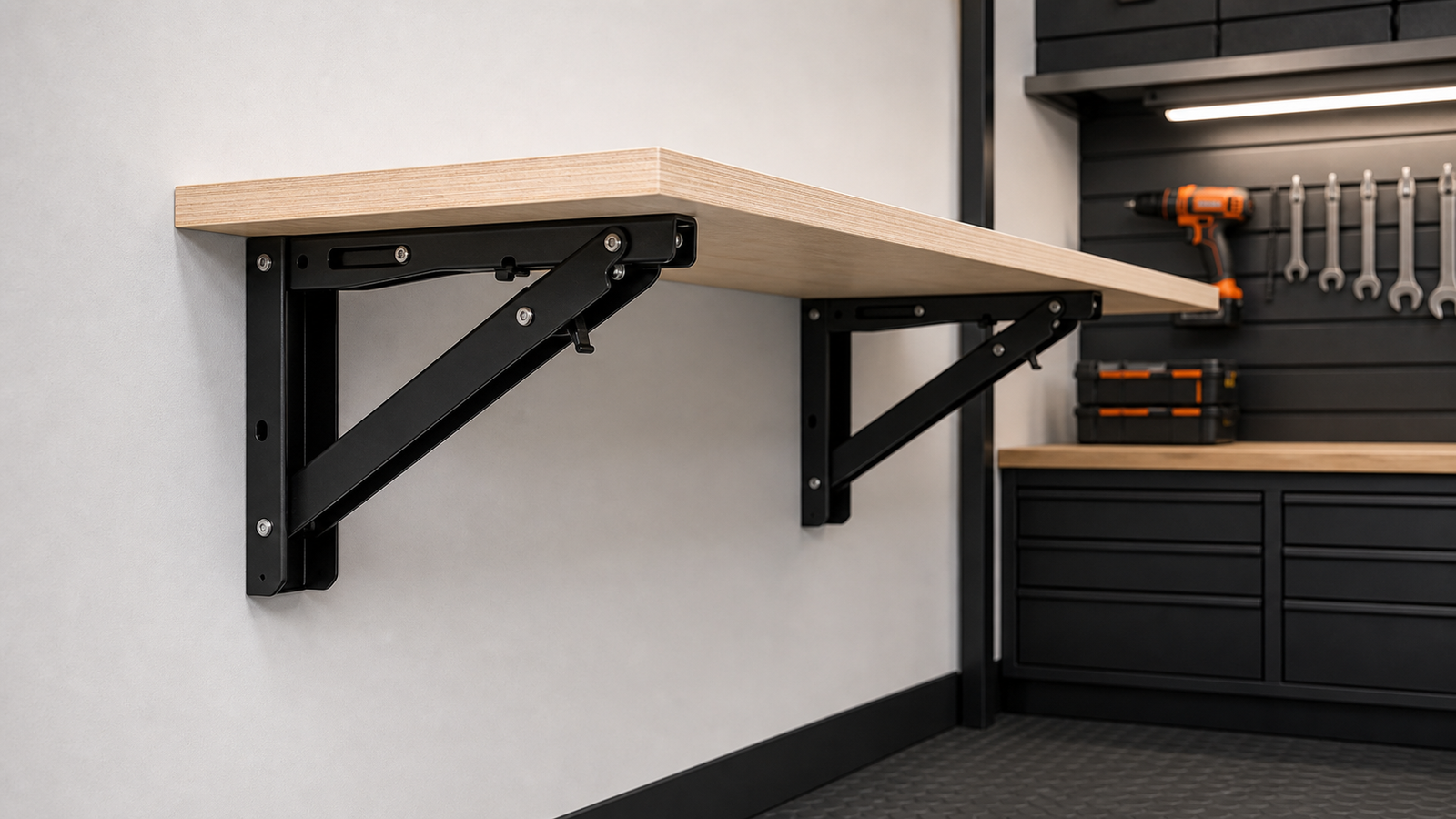
Quick answer
Use a shelf board thick and stiff enough for the span between brackets and the expected load. Thin boards can sag even on strong brackets, while very thick boards may need longer screws, more clearance, and careful folded-position planning.
Board stiffness matters as much as bracket strength
A folding bracket supports the shelf at specific points. Between those points, the board has to carry its own span. If the board is too thin or too soft, the front edge can dip, the shelf can bounce, and the bracket assembly may look weaker than it really is.
This is why real shelf capacity is a system: brackets, wall backing, fasteners, shelf board, depth, spacing, and load placement all matter together.
How to choose board thickness
Material choice
Plywood is often practical for utility shelves because it is stable and predictable. Hardwood can be strong and attractive, but it can move with humidity. Particleboard and thin laminated panels may need extra support, especially near screw holes or the front edge.
For visible surfaces, finish the board edges and seal the material for the environment. Laundry rooms, RVs, garages, and outdoor-adjacent areas may see moisture or temperature changes.
Board checklist
- Confirm the board can span between brackets without visible deflection.
- Match board depth to bracket size and support reach.
- Use shelf-side screws that hold securely without protruding through the top.
- Keep heavy items closer to the wall where practical.
- Test the shelf with gradual load before normal use.
COREAX product match
COREAX folding shelf brackets provide the folding support hardware. Pair them with a stiff shelf board and reinforced wall backing for the intended load.
View Folding Shelf BracketsFAQ
Can a thin shelf board work with strong folding brackets?
Only for light loads and short spans. A thin board can sag between strong brackets if the shelf is long, deep, or used as a work surface.
Does shelf depth affect wood thickness?
Yes. Deeper shelves create more leverage at the front edge and usually need a stiffer board and stronger support plan.
Can shelf screws poke through the top?
Yes, if the board is too thin or the screws are too long. Check board thickness and screw length before fastening the shelf to the brackets.
Move to the next decision.
Use the next guide in the same planning path, then verify the exact product before ordering.