
Folding Bracket Material And Finish
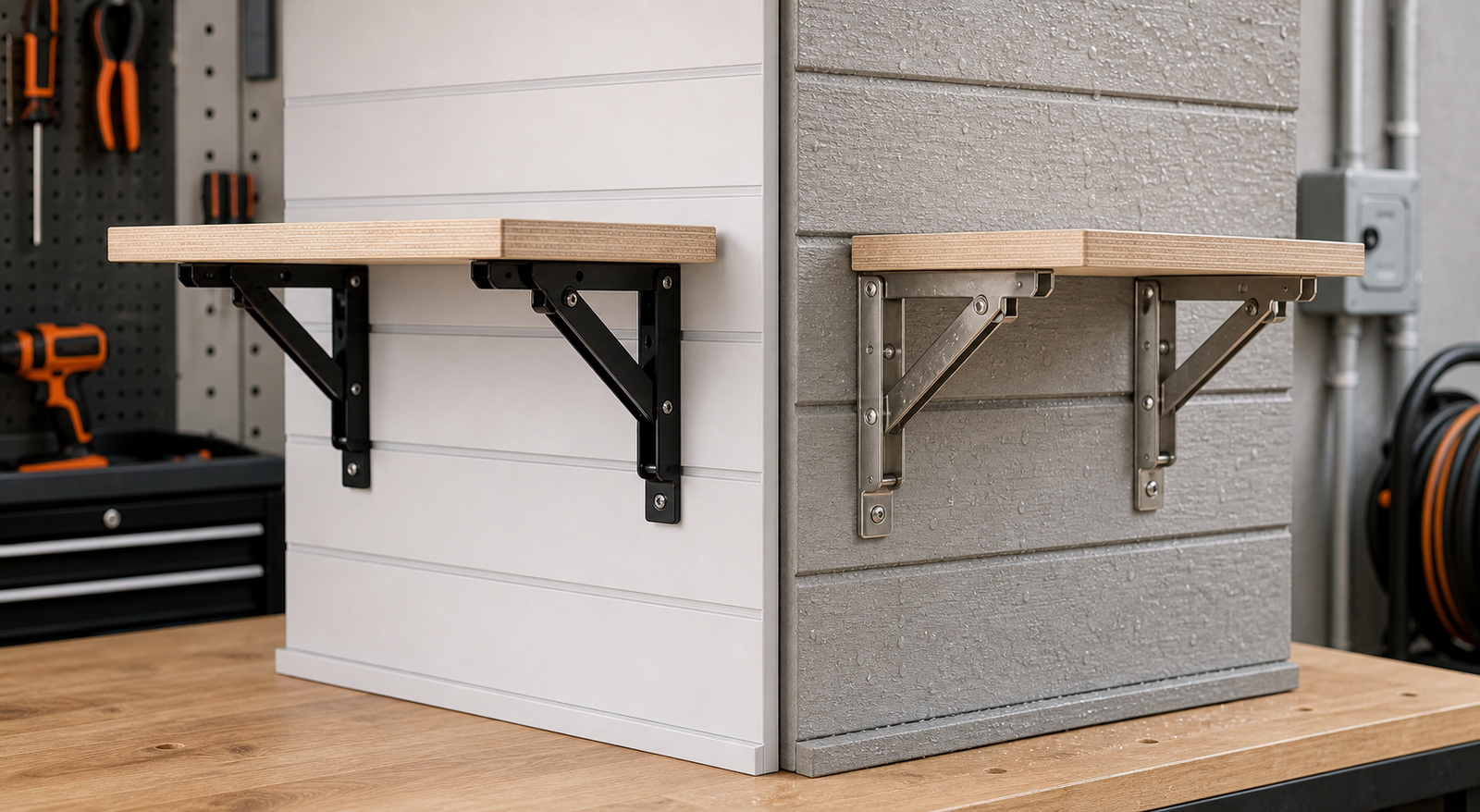
Black vs stainless steel folding shelf brackets.
Choose black coated carbon-steel brackets for dry interiors where appearance, price, and an intact coating suit the project. Choose stainless brackets as the stronger starting point for moisture, frequent cleaning, outdoor or marine-like exposure, and environments where scratches may reveal the base material. Verify the exact material, coating, fasteners, contaminants, and maintenance rather than choosing by color alone.
- Published by
- COREAX
- Technical review
- COREAX Product Support
- Published
- Updated
Direct answer
Use environment and maintenance to choose the finish.
Black carbon-steel brackets generally fit dry garages, offices, laundry areas, workshops, and RV interiors when the coating remains intact and the visual design favors dark hardware. Stainless brackets are generally preferable where condensation, splashes, outdoor humidity, frequent washing, food preparation, coastal salts, or cleaning chemicals make coating damage and corrosion more consequential.
Stainless is not “rust-proof,” and black is not automatically unsuitable near moisture. The exact stainless alloy, surface condition, fabrication contamination, coating system, fasteners, drainage, salts, temperature, and cleaning practice determine performance.
Decision matrix
Compare the complete environment.
| Decision | Black coated carbon steel | Stainless steel |
|---|---|---|
| Dry indoor appearance | Dark low-contrast hardware; often blends with black frames and cabinetry | Bright or brushed metallic appearance |
| Coating damage | Scratch can expose carbon steel and create a local corrosion point | No separate paint layer required for basic material corrosion resistance, but surface contamination and grade still matter |
| Moisture and cleaning | Suitable when coating and edges remain protected and exposure is controlled | Generally better starting point for repeated moisture and cleaning |
| Coastal/salt exposure | Higher dependence on coating condition, rinsing, and maintenance | Often preferable, but grade and chloride exposure remain critical |
| Visible wear | Scratches can show a contrasting base and may require touch-up | Scratches may be less visually contrasting, though finish direction and staining can change |
| Fastener compatibility | Use suitable coated/plated or compatible fasteners for the environment | Use compatible stainless or specified fasteners while considering galling and dissimilar-metal contact |
| Maintenance | Inspect coating, chips, cut edges, and fastener corrosion; clean and touch up as appropriate | Clean deposits, avoid incompatible cleaners/steel contamination, inspect tea staining and crevices |
Black bracket system
The coating is part of the corrosion system.
A black bracket may use powder coating, paint, plating, or another finish over carbon steel. The coating separates steel from moisture and oxygen while also providing color. Corrosion can begin where the finish is scratched, chipped, thin at edges, damaged during drilling, or penetrated by incompatible fasteners.
Stainless bracket system
Stainless relies on alloy and surface condition, not immunity.
Stainless steel forms a chromium-rich passive surface that improves corrosion resistance. Performance varies by alloy family and environment. Chlorides, crevices, deposits, heat tint, embedded carbon-steel particles, and incompatible cleaners can produce staining or corrosion. A “stainless color” product is not proof of stainless material.
- Verify the product actually specifies stainless material.
- Use compatible fasteners for the exposure and connection.
- Avoid carbon-steel wire brushes or tools that embed iron contamination.
- Remove salt, dirt, grease, and deposits before they remain in crevices.
- Follow compatible cleaning guidance and rinse where appropriate.
- Inspect hinges, welds, fastener interfaces, and wall contact zones.
- Do not assume all stainless grades provide equal chloride resistance.
Application map
Choose according to the actual exposure.
| Application | Likely starting choice | Additional checks |
|---|---|---|
| Dry indoor garage | Black or stainless according to appearance and budget | Humidity, cleaning chemicals, wet vehicles, road salt brought indoors |
| Laundry room | Either; stainless gains value near sinks, wet garments, or frequent spills | Detergent chemicals, condensation, wall moisture, cleaning access |
| Kitchen or food prep | Stainless often preferred for cleaning and moisture exposure | Food-contact surfaces remain separate, cleaner compatibility, wall backing |
| RV interior | Black for dry styled interior; stainless near wet galley or exterior access | Condensation, vibration, travel latch, lightweight wall structure |
| Outdoor covered shelf | Stainless generally stronger starting point | Rain direction, condensation, drainage, salt, compatible fasteners, wood treatment |
| Coastal or marine-like area | Verified suitable stainless system | Stainless grade, chloride exposure, rinsing, crevices, dissimilar metals |
| Workshop with chemicals | Choose by exact chemical compatibility, not color | Solvents, acids, alkalis, abrasives, metal dust, cleaning method |
Fastener compatibility
A bracket and fastener can corrode differently.
Fasteners penetrate the protective finish and create contact between metals. Select wall and shelf fasteners for substrate, load, and environment. Stainless fasteners can reduce one corrosion path in wet applications but can gall during assembly and create galvanic interactions with aluminum or other metals. Plated fasteners can lose coating during installation. Use product-specific data and protect drilled or cut surfaces.
Cleaning and maintenance
Use routine cleaning to preserve both appearance and function.
Strength and material myths
Finish choice does not replace capacity planning.
COREAX product boundary
The relevant finish decision belongs to the folding-bracket family.
The broad “black vs stainless hardware for garage and RV builds” page is consolidated here because COREAX’s direct black/stainless choice applies primarily to folding shelf brackets. COREAX offers black carbon-steel and stainless bracket paths in 8–16 inch sizes, sold as a pair, with a wide flat-tab release and up-to-300-lb per-pair family claim under applicable product conditions.
Verify the selected size and finish. Product material/finish does not certify outdoor, marine, food-processing, chemical, or vehicle use without application-specific review.
Finish decision
Choose in six steps.
- 01Classify exposure
Dry indoor, intermittent splash, humid, outdoor, coastal, chemical, or vehicle.
- 02Identify cleaning method
Water, detergent, disinfectant, degreaser, abrasive, salt rinse, or no routine cleaning.
- 03Check likely damage
Tool impacts, shelf rubbing, fastener installation, folding wear, and visible scratches.
- 04Select compatible fasteners
Match substrate, load, finish/material, corrosion exposure, and installation method.
- 05Plan drainage and inspection
Avoid trapped moisture and make hinges, plates, and fasteners visible.
- 06Verify product and complete load path
Finish selection does not replace bracket size, spacing, wall, fastener, and shelf-capacity decisions.
Evidence and corrosion boundary
Stainless maintenance and coated-steel selection remain environment-specific.
Technical sourcesThe Nickel Institute’s stainless maintenance guide discusses routine cleaning, removal of contamination, cleaner selection, and maintenance of stainless architectural surfaces. Accuride’s corrosion-resistant slide guidance similarly emphasizes selecting material and finish for moisture, chemicals, and corrosive environments rather than relying on appearance alone.
- worldstainless: Cleaning and MaintenanceIndustry guidance and linked technical publications on routine cleaning, contamination, discoloration, and surface care for stainless steel.
- Accuride Corrosion-Resistant Hardware GuidanceManufacturer overview of stainless and coated hardware selection for moisture, chemical, and corrosive environments.
Evidence boundary: These sources do not establish the exact stainless grade or coating performance of every COREAX variation or certify marine, food, chemical, or outdoor service. Verify current product specifications and evaluate the complete environment, fasteners, wall, and maintenance plan.
COREAX product path
Send the exposure and cleaning conditions with the shelf plan.
Provide selected bracket size, shelf and wall details, indoor/outdoor/RV location, moisture and salt exposure, cleaning chemicals, compatible fastener plan, expected scratches/impact, and maintenance access. Then select the COREAX black or stainless folding bracket variation that best fits.
Common questions
Black vs stainless bracket FAQ
Are stainless folding brackets better for outdoor use?
They are generally the stronger starting point for moisture and outdoor exposure, but stainless grade, salts, crevices, fasteners, cleaning, and maintenance still need review.
Can black folding brackets be used in a laundry room?
They can suit a dry or controlled laundry environment when the coating remains intact. Near frequent splashes, condensation, or aggressive cleaners, stainless may provide a more durable starting point.
Does stainless steel mean the bracket cannot rust?
No. Stainless can stain or corrode with unsuitable grade, chlorides, trapped moisture, contamination, crevices, or incompatible cleaning.
Are black and stainless COREAX brackets rated differently?
Do not infer capacity from color or material alone. Use the selected variation’s current product specifications and verify the complete shelf, wall, fasteners, spacing, and load path.
Absorbed the broad garage/RV finish comparison and rebuilt the canonical page around substrate/coating, stainless behavior, exposure map, fastener compatibility, cleaning, myths, COREAX boundary, six-step decision, sources, and FAQ.
Move to the next decision.
Use the next guide in the same planning path, then verify the exact product before ordering.