
Drawer Slide Comparison
Heavy-duty vs undermount drawer slides.
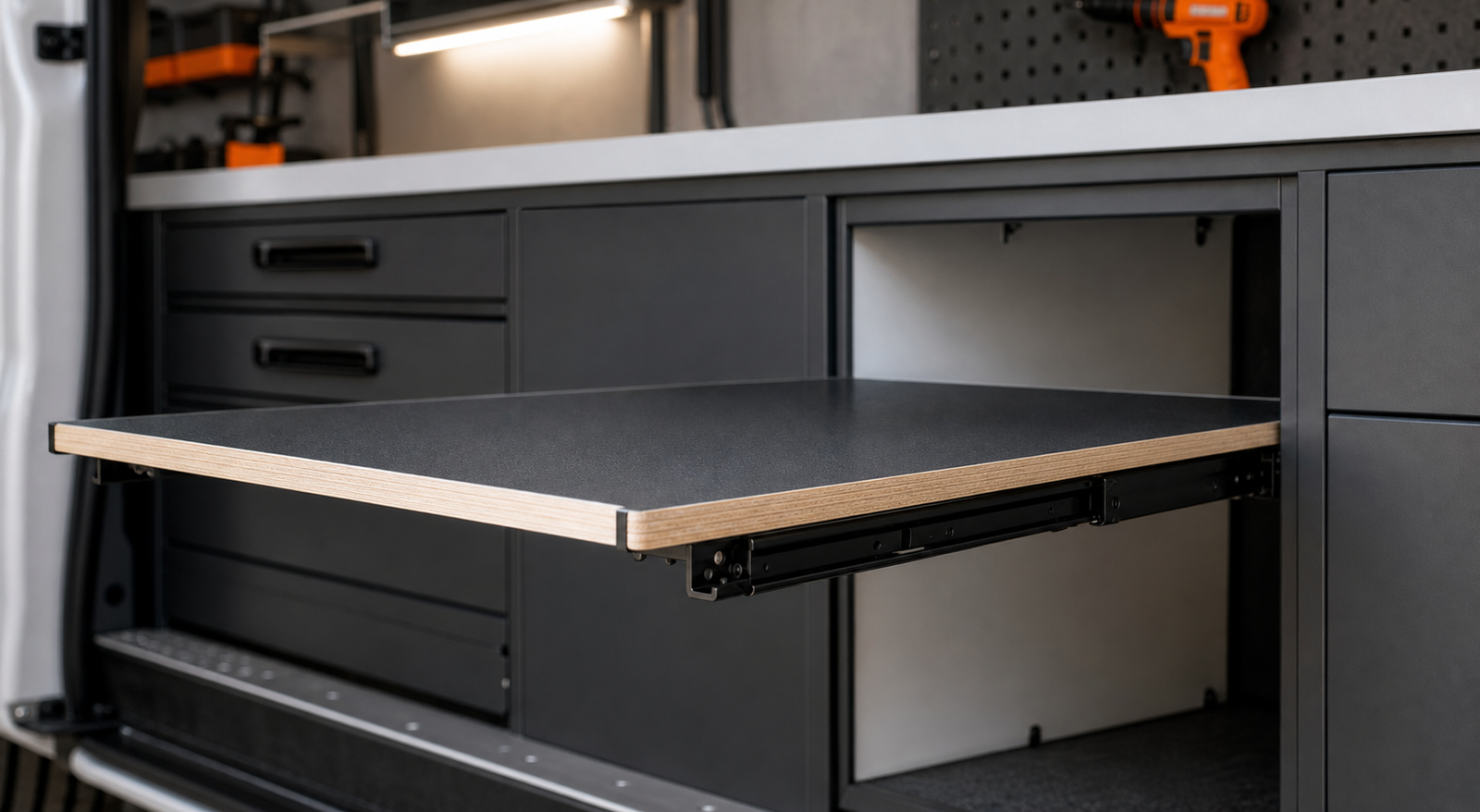
Choose heavy-duty side-mount slides for large moving loads, long travel, vehicle storage, positive lock control, and serviceable exposed frames. Choose a true bottom-mount or concealed undermount system for lighter cabinet pull-outs where the load path, drawer construction, and appearance are designed around support from below.
- Published by
- COREAX
- Technical review
- COREAX Product Support
- Published
- Updated
Direct answer
The deciding question is not “which is stronger?”
Ask what structure will carry the moving load. Heavy-duty side-mount slides transfer load through vertical drawer and frame faces and are generally easier to integrate into truck drawers, equipment trays, wide utility pull-outs, and rigid welded or plywood frames. Bottom-supported or concealed undermount systems transfer load through the shelf or drawer underside and rely on a different drawer geometry, mounting pattern, and racking control.
Neither category is automatically better. A high-capacity side-mount slide can still bind on a flexible frame. A well-designed bottom-mount pull-out can be the cleaner solution for a pantry or vanity but can be unsuitable for a wide vehicle tray. The correct comparison is application, load path, exact model, and surrounding structure.
Decision matrix
Compare the two systems by the build requirement.
| Decision | Heavy-duty side-mount | Bottom-mount / undermount |
|---|---|---|
| Typical task | Truck drawers, RV exterior trays, generator platforms, large tool drawers, service vehicles | Pantry shelves, trash pull-outs, vanity storage, appliance trays, conventional cabinet drawers |
| Load path | Through two vertical mounting faces into a rigid frame | Through the drawer or shelf underside into runners, brackets, or locking devices |
| Visibility | Rails are visible from the side unless concealed by the drawer or enclosure | Hardware is hidden or visually quieter beneath the moving member |
| Clearance | Requires known side space on both sides; COREAX LD2053 and L2576 use approximately 19 mm per rail | Requires bottom geometry, rail spacing, shelf thickness, notches, or model-specific drawer preparation |
| Position control | Available with lock-in, lock-out, integrated releases, or linkage-ready levers | Often soft-close or self-close; vehicle restraint may require a separate latch |
| Service access | Members and fasteners are usually easier to inspect in an open frame | Access can be tighter; some systems disconnect and others require removing the complete assembly |
| Frame demand | Both vertical faces must remain parallel under full extension and load | The base, shelf, drawer box, and runner engagement must remain square and stiff |
When heavy-duty side-mount wins
Use it when load, travel control, and an exposed structural frame dominate the decision.
A truck bed drawer or RV equipment tray is more than a cabinet drawer. The moving assembly may be long, wide, fully extended over open space, exposed to vibration, and loaded with dense tools, batteries, recovery equipment, a refrigerator, or a generator. Vertical side mounting makes it possible to build a rigid frame around the rails and inspect the connection after service.
Heavy-duty slides are also the stronger route when the drawer must remain positively controlled at both end positions. Lock-in helps resist unintended opening while traveling; lock-out holds the tray at full extension while loading or working. These functions are separate from soft-close. Confirm the exact model because some products provide only a hold-in detent, lock-out only, or no lock.
When bottom support wins
Use it when the cabinet, shelf, and appearance are designed around support from below.
A compact pantry shelf, trash tray, laundry organizer, or vanity pull-out may not need large locking rails on both sides. Support from below can keep side edges open and reduce visible hardware. It can also work where conventional drawer side panels are absent, provided the exact system is intended for a platform or shelf and the base is stiff enough to distribute load.
“Undermount” is not one universal format. Concealed cabinet runners such as Blum TANDEM or MOVENTO use a prepared drawer box, locking devices, and model-specific installation dimensions. A true bottom-mount platform slide uses brackets or a broad underside connection. COREAX’s black bottom-mount family is intended for bottom-supported shelves and trays; it should not be described as a drop-in replacement for every concealed undermount drawer system.
Space planning
The hidden cost is the space each system consumes.
Side-mount slides reduce available drawer width. Two 19 mm rails consume approximately 38 mm before any additional tolerance or release space. A wide 76 mm slide also needs vertical room and front access around the lock lever. Bottom-supported systems preserve side appearance but consume space below the shelf and may require notches, locking clips, rear brackets, or a higher drawer bottom.
Measure the actual product rather than using a category average. Record the clear opening at the front, middle, and rear; use the narrowest value; then subtract the complete required hardware envelope. Review Drawer Slide Side Clearance and How to Measure for Drawer Slides before cutting the drawer.
Failure modes
Each system fails differently when the surrounding build is wrong.
Evidence and terminology
Why the mounting and model conditions matter.
Manufacturer sourcesAccuride’s 9300 family publishes side-mount, full-extension, stationary/mobile, and lock-in/lock-out information as distinct conditions rather than one interchangeable capacity statement. Blum’s runner instructions require matching the exact concealed runner kit and following its system-specific installation sheet. Together, these sources illustrate why “heavy-duty” and “undermount” must be compared as complete systems.
- Accuride 9300 SeriesOfficial heavy-duty side-mount examples with full extension, separate stationary/mobile conditions, and lock variants.
- Blum Runner Assembly InstructionsOfficial model-specific instructions for concealed undermount runner kits and required installation procedures.
Evidence boundary: External product ratings apply only to the named manufacturers and models. COREAX specifications above come from the current COREAX catalog; they are not presented as equivalent third-party test results. Verify the selected COREAX variation and completed installation under intended load.
COREAX product path
Choose the family after the load path is clear.
Use LD2053 heavy-duty locking slides for wide or deep pull-outs that benefit from an integrated single-side release. Use L2576 76 mm locking slides for longer or heavier custom frames where the builder will design the linkage. Use COREAX black bottom-mount slides for lighter bottom-supported shelves and compact cabinet pull-outs where soft-close and low side visibility matter.
Common questions
Heavy-duty vs undermount FAQ
Are heavy-duty drawer slides always stronger than undermount slides?
No universal comparison is valid without the exact models and conditions. Heavy-duty side-mount slides are generally built for larger moving loads and exposed frames, while undermount systems can perform well in the drawer and cabinet geometry for which they were designed.
Can I use undermount slides for a truck bed drawer?
Only when the exact system is documented for the load, width, orientation, vibration, restraint, and frame. Most cabinet-focused soft-close undermount systems should not be assumed to be vehicle-rated.
Do bottom-mount slides eliminate side-clearance measurements?
They change the measurement rather than eliminate it. You still need clear opening, rail spacing, shelf width, bottom clearance, hinge intrusion, and model-specific mounting dimensions.
Which COREAX slide is best for a pull-out shelf without side panels?
Start with the COREAX black bottom-mount family when the shelf is bottom-supported and within its size and load conditions. Use the open-shelf guide to verify shelf stiffness, rail alignment, and racking control before ordering.
Rebuilt the comparison around load path, mounting structure, space, lock behavior, failure modes, current COREAX product families, manufacturer sources, and explicit evidence boundaries.
Move to the next decision.
Use the next guide in the same planning path, then verify the exact product before ordering.