
Open Pull-Out Shelf Guide
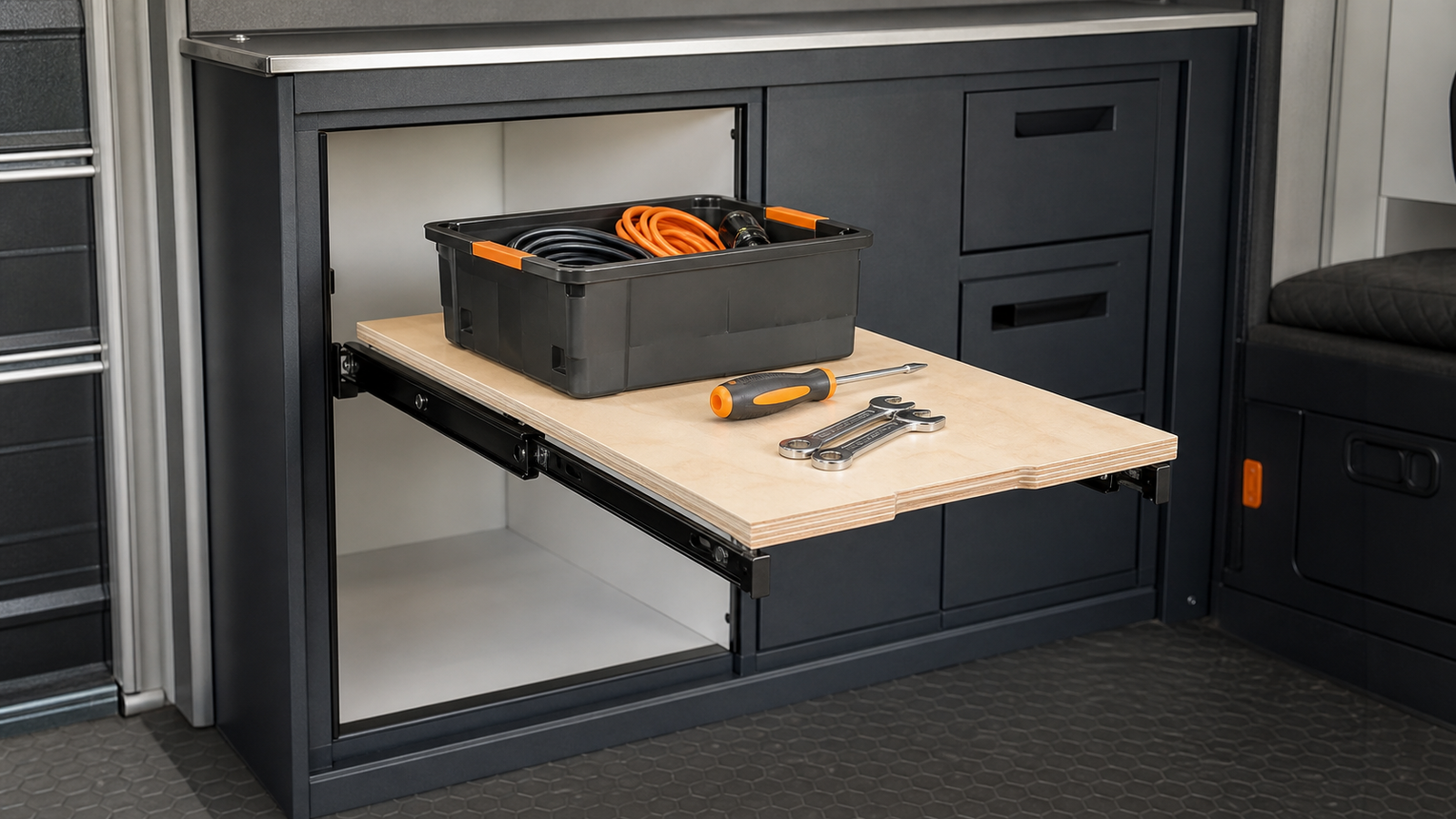
Drawer slides for shelves without side panels.
Yes—if the slide is designed to support a shelf or platform from below. Removing the drawer-box sides changes the load path, so the cabinet base, rail alignment, shelf stiffness, fasteners, and travel restraint all become part of the slide system.
Direct answer
No side panels does not mean no supporting structure.
Use purpose-designed bottom-supported or platform-mount hardware. Do not rotate an ordinary side-mount slide flat unless its manufacturer explicitly supplies a flat-mount rating and installation method. The shelf must stay flat, and both cabinet-side rails must remain parallel and coplanar under the working load.
Load path
Where the weight goes without a drawer box.
A conventional side-mount drawer transfers load through two vertical drawer walls. An open shelf transfers it through the platform underside, fasteners, moving rails, fixed rails, and finally the cabinet base or support frame.
Go / no-go check
Five conditions decide whether the open shelf is viable.
Both fixed rails have continuous, rigid mounting surfaces or engineered support rails—not thin unsupported cabinet skin.
The shelf underside gives the moving members a straight mounting plane and resists sag or twist across its span.
Front and rear spacing match, both rails sit at the same height, and fastener heads do not enter the moving path.
The shelf, bins, appliances, liquids, handles, and contents all count toward the load—not just what sits on top.
The shelf clears doors and hinges, stays contained when closed, and cannot roll out unexpectedly in a moving or sloped installation.
Hardware distinction
“Undermount” is a location, not a universal installation pattern.
Verify the exact modelSome concealed undermount systems are engineered around a drawer box, locking devices, and exact drawer dimensions. Other slides use brackets or profiles intended for a shelf or platform. The product drawing—not the category name—decides whether side panels are optional.
- Accuride 301-2590Official example of a slide with brackets specifically described for top- or bottom-surface shelf and platform mounting.
- Blum TANDEM planning pageOfficial example of a concealed runner whose drawer width, drawer length, locking-device geometry, and cabinet space are specified as a coordinated drawer-box system.
Evidence boundary: These manufacturer examples show why mount orientation and platform compatibility are model-specific. They are not test results for COREAX hardware.
Application boundary
Where an open shelf works—and where a drawer box is safer.
- Pantry shelves and low-lip organizers
- Trash-bin or laundry pull-outs
- Printer and compact appliance trays
- Stationary cabinets with a solid base
- Wide shelves that visibly flex or rack
- High or shifting loads with no side retention
- Vehicle installations without a separate latch
- Cabinets whose base cannot hold both rails square
Measurement sheet
Record the structure before choosing the slide.
COREAX product fit
A true bottom-supported option for stationary pull-outs.
COREAX CX-BM-SL black undermount slides are cataloged for direct base-panel support, open shelves without side panels, soft-close movement, and a total load up to 88 lb. Available nominal sizes are 10, 12, 14, 16, 18, and 20 inches; actual item length is slightly longer than the nominal label, so verify the selected variation before ordering.
This product does not provide the lock-in/lock-out behavior of COREAX LD2053. Use a separate, suitable restraint where unintended movement is possible.
Check sizes and specificationsFAQ
Do pull-out shelves need side panels?
No. A shelf can remain open when the exact slide supports a platform from below and the shelf, base, rail alignment, and fasteners carry the working load.
Can I mount standard side-mount slides flat under a shelf?
Only when the manufacturer explicitly permits that orientation and publishes the applicable load rating. Flat mounting can reduce capacity and changes how the slide carries load.
Why does an open pull-out shelf bind?
Common causes are unequal front/rear rail spacing, rails on different planes, a twisted shelf, base flex, or fastener heads interfering with movement.
Do I need a latch in an RV or vehicle?
A soft-close mechanism is not a travel lock. Use a restraint designed for the expected movement and verify that it holds the loaded shelf closed.
Added a structural load-path diagram, five-condition viability check, model-specific evidence, application boundaries, measurement sheet, COREAX product limits, and mobile-use restraint guidance.
Move to the next decision.
Use the next guide in the same planning path, then verify the exact product before ordering.