
Drawer Slide Orientation Safety
Can drawer slides be mounted flat?
Only when the exact slide is designed or documented for horizontal, top, bottom, or platform mounting. Do not rotate a side-mount drawer slide flat and apply its vertical side-mount load rating. The members, bearings, brackets, deflection, fasteners, and test conditions change with orientation.
- Published by
- COREAX
- Technical review
- COREAX Product Support
- Published
- Updated
Direct answer
Mount the slide in the orientation used for its published rating.
A side-mount slide is normally tested and specified with its members vertical, one rail on each drawer side. In that position, the bearing and member geometry resists the load through the intended cross-section. When the same rail is laid flat under a shelf, the members bend in a different direction and the balls or rollers contact different surfaces. Capacity, deflection, travel quality, lock behavior, and life can change substantially.
There is no reliable universal rule such as “flat mounting reduces capacity by exactly 50%.” Use a manufacturer-supplied flat-mount rating or choose hardware explicitly designed for bottom, top, or platform mounting.
Load path
Turning the rail changes how every component carries load.
When flat or bottom mounting is allowed
Look for explicit documentation, not a photo that looks similar.
A slide can be suitable below a platform when it is designed with brackets, tabs, broad mounting surfaces, or a product architecture intended for top/bottom support. The technical sheet should state the permitted configuration, load, width, travel, fasteners, and any bracket spacing or platform limits.
| Documentation | Decision |
|---|---|
| Exact product says side-mount only | Install vertically on the sides; do not transfer the rating to flat mounting. |
| Exact product provides a separate flat-mount rating | Use only the stated orientation, load, width, and installation conditions. |
| Exact product includes top/bottom mounting brackets | Follow the bracket positions, fasteners, platform dimensions, and published load. |
| Product is a concealed undermount runner | Follow its drawer-box preparation, locking devices, rear brackets, and cabinet dimensions. |
| No orientation information is available | Do not assume; obtain technical confirmation or choose documented bottom-supported hardware. |
COREAX product boundary
LD2053 and L2576 should remain side-mounted.
COREAX LD2053 and L2576 are side-mount heavy-duty locking drawer slides. Their approximately 19 mm per-rail thickness, vertical profiles, lock mechanisms, and listed specifications apply to that orientation. This guide does not provide a flat-mount capacity for either family.
Open shelves without side panels
Choose a system that controls shelf sag and racking.
An open shelf can work without conventional drawer sides when the hardware carries the shelf from below and the shelf remains stiff. The rails must stay parallel; the shelf must distribute load; and the installation must resist side-to-side racking. A thin panel can sag between rails even when the slide pair is adequately rated.
Use the five-condition go/no-go process in Drawer Slides for Pull-Out Shelves Without Side Panels. Check shelf material and thickness, unsupported span, rail spacing, load position, front restraint, and cabinet base structure.
Common myths
Rules of thumb cannot replace an orientation rating.
Risk check
Stop the flat-mount plan when any of these are true.
- The manufacturer identifies the slide only as side-mount.
- No flat-mount or platform rating is published.
- The shelf carries a person, seat, step, sleeping platform, or safety-critical equipment.
- The application moves in a vehicle and no mobile flat-mount condition is available.
- The shelf is wide, flexible, or carries a front-concentrated load.
- The lock or release relies on an orientation that changes when rotated.
- The fasteners would load thin sheet, edge grain, or unsupported panel material in pull-out.
- The installation cannot be inspected after the shelf is assembled.
Safer alternative workflow
Redesign around purpose-built support.
- 01Define the platform
Measure width, depth, thickness, complete moving weight, load position, and required travel.
- 02Choose the load path
Use vertical side frames for side-mount slides or documented bottom-support hardware for an open shelf.
- 03Check racking control
Confirm the shelf and rail spacing resist twisting when the user pulls from one side.
- 04Verify travel and restraint
Choose partial/full/over-travel and separate closed/open restraints according to the application.
- 05Test within documented conditions
Install the exact hardware as specified and validate the completed assembly under gradual representative load.
Evidence and exceptions
Purpose-designed platform slides publish the difference.
Manufacturer sourcesAccuride’s 9300 family is presented as a heavy-duty side-mount system with full extension and model-specific rating conditions. Its 301-2590 is a different design with attached brackets that explicitly allow mounting to the top or bottom surface of a case and publishes platform width, travel, and load conditions. This contrast illustrates why orientation permission must come from the exact product.
- Accuride 9300 SeriesOfficial side-mount heavy-duty example with full-extension and model-specific rating conditions.
- Accuride 301-2590 Platform SlideOfficial example with attached top/bottom mounting brackets, platform-width limit, load rating, and over-travel.
Evidence boundary: The Accuride examples do not authorize flat mounting for COREAX side-mount slides. COREAX does not publish a flat-mount rating for LD2053 or L2576 in the current product data. Use exact documented bottom-mount or worktop hardware instead.
COREAX product path
Keep heavy-duty locking rails vertical or change the product architecture.
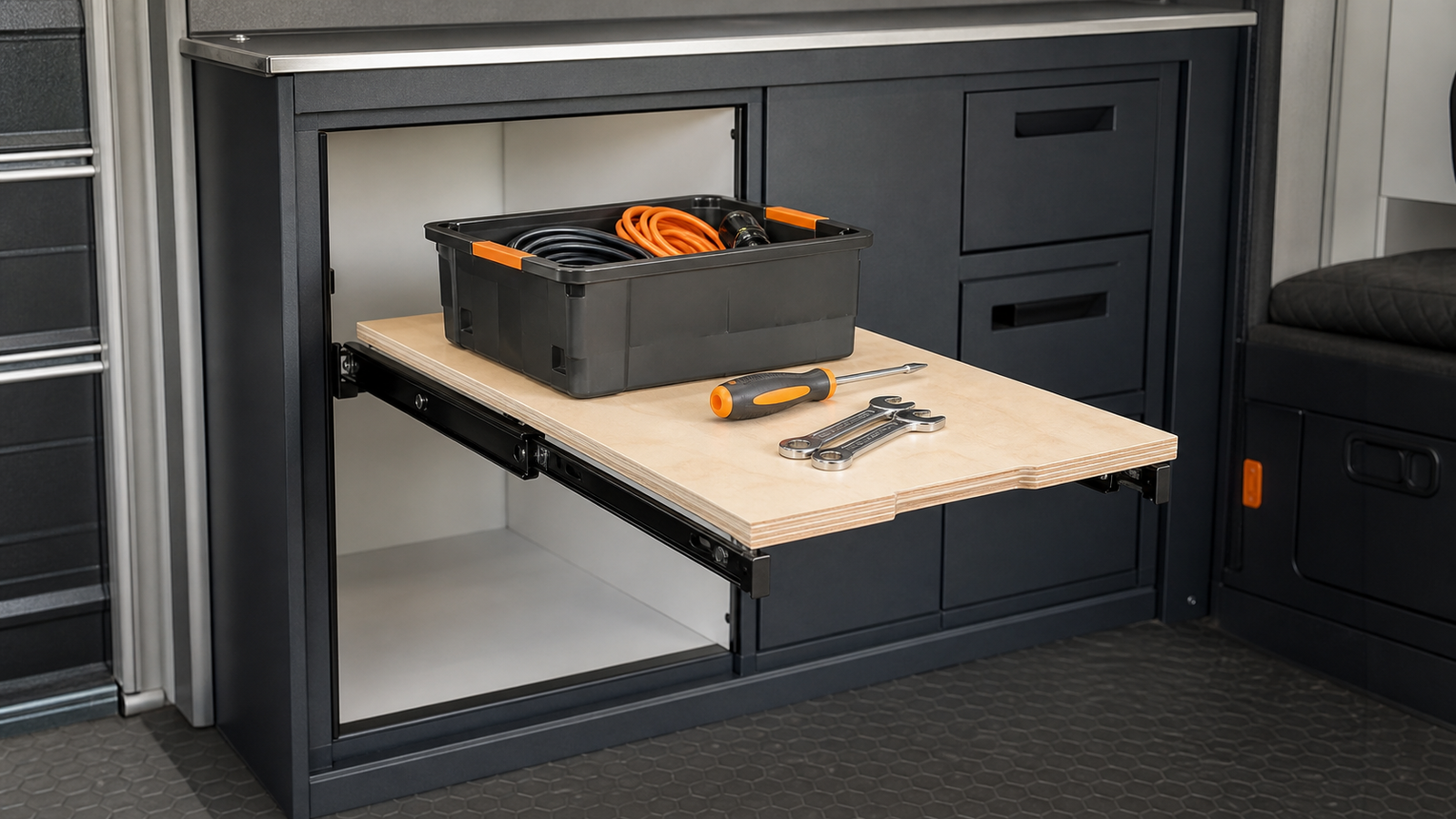
Use LD2053 or L2576 between rigid vertical side faces. For a compact open shelf supported from below, evaluate COREAX black bottom-mount slides. For a supported retractable worktop, use the COREAX pull-out worktop kit and follow its top/bottom mounting layout.
Common questions
Flat-mount drawer slide FAQ
How much capacity does a side-mount slide lose when mounted flat?
There is no universal reduction percentage. Use a separate manufacturer-published flat-mount rating for the exact model or choose hardware designed for bottom/platform mounting.
Can COREAX LD2053 or L2576 be mounted under a shelf?
The current COREAX product data presents both as side-mount locking slides and does not provide a flat-mount capacity. Install them vertically or choose documented bottom-supported hardware.
What should I use for an open pull-out shelf?
Use a true bottom-mount, platform, or worktop system designed to carry the shelf from below, and verify shelf stiffness, width, rail spacing, load, and racking control.
Can I test a flat-mounted slide myself and use it?
A casual load test does not establish cycle life, impact behavior, deflection, safety factors, or regulatory suitability. For nontrivial or safety-critical applications, use documented hardware or qualified engineering.
Added exact orientation boundary, load-path explanation, documented exceptions, COREAX product-specific position, myth correction, risk checklist, alternative workflow, manufacturer sources, and FAQ.
Move to the next decision.
Use the next guide in the same planning path, then verify the exact product before ordering.