
Garage Storage Format Comparison
Garage storage shelf and tray hardware.
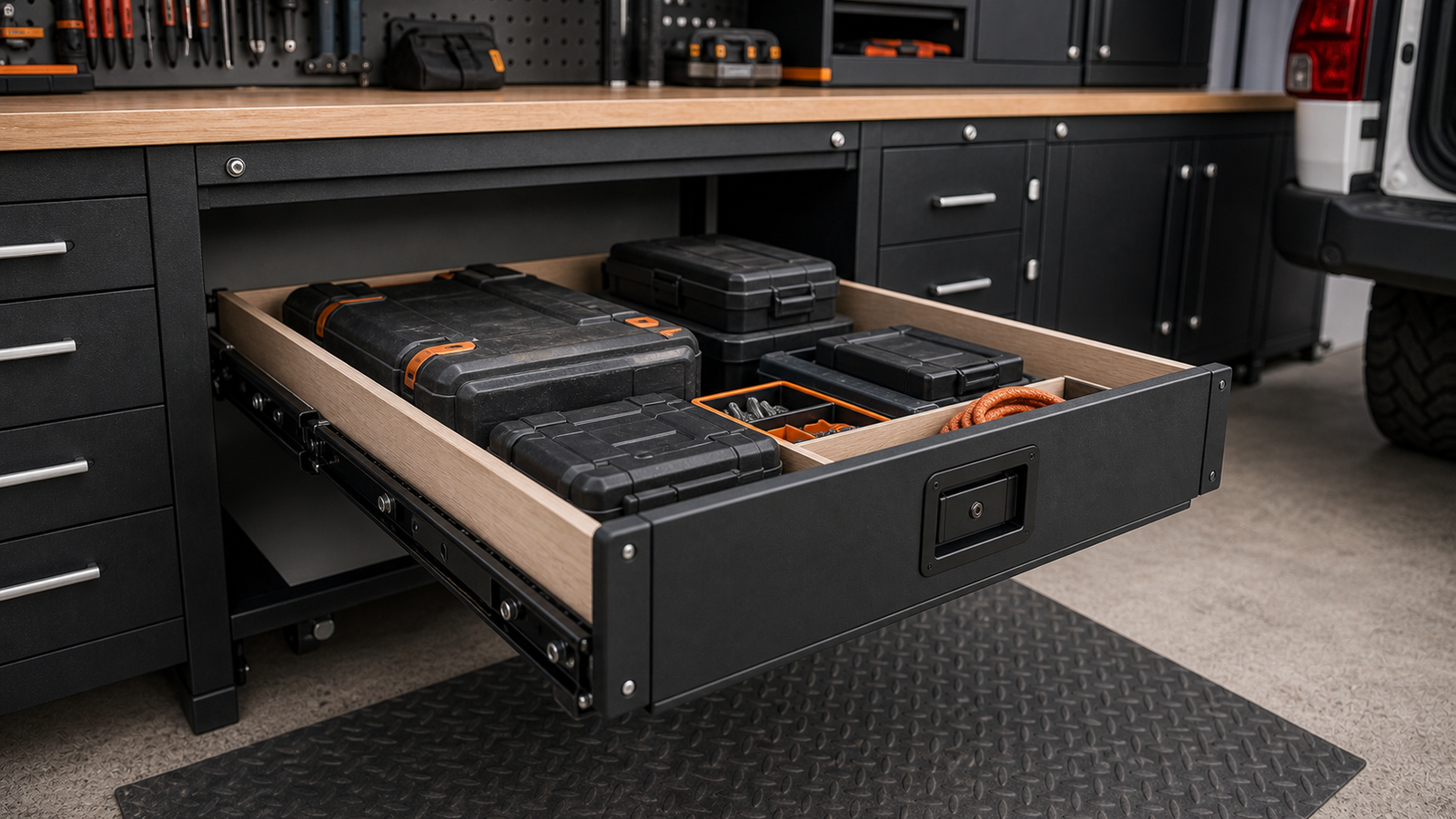
Choose fixed shelves for maximum simplicity, folding shelves for temporary work surfaces, bottom-supported pull-outs for compact cabinet access, and heavy locking drawer slides for dense tools or mobile equipment trays. The best format depends on access frequency, load, wall or cabinet structure, floor space, dust, liquids, restraint, and how much hardware must move.
- Published by
- COREAX
- Technical review
- COREAX Product Support
- Published
- Updated
Direct answer
Use the simplest storage format that provides the required access.
Use a fixed shelf when items can be lifted directly and the surface does not block work space. Use a pull-out shelf when a deep lower cabinet hides contents but loads remain within a bottom-supported system. Use a heavy drawer when dense tools or equipment need full-extension access and a rigid frame. Use folding brackets when the garage needs a work surface only during use.
Every moving format adds hardware, lost space, maintenance, alignment, and failure points. Do not install heavy slides or folding mechanisms where a fixed shelf, removable bin, or simple door provides equal access.
Storage-format matrix
Compare the whole system, not only hardware capacity.
| Format | Best for | Main advantages | Main limits |
|---|---|---|---|
| Fixed shelf | Bins, paint, seasonal items, bulk supplies | Low cost, low weight, few moving parts, easy load path | Rear access can be poor; permanent floor/wall space |
| Folding shelf/workbench | Temporary assembly, laundry, packing, light tool work | Creates surface only when needed | Wall/backing critical; remove loose items before folding; not human support |
| Bottom-supported pull-out shelf | Cleaning supplies, compact tools, appliances, lower cabinet bins | Rear access, low side visibility, soft-close options | Cabinet base and shelf stiffness control; travel latch if mobile |
| Standard cabinet drawer | Hand tools, fasteners, small parts | Organization, dust protection, compact runner options | Drawer-box construction and load limits |
| Heavy-duty full-extension drawer | Dense tools, batteries, equipment, rolling/mobile workstations | High-load product options, complete access, lock options | Large side space, rigid frame, higher cost/weight |
| Mobile cart | Tools used across garage zones | Moves to task; independent of wall | Floor space, caster/load stability, roll-away restraint |
Inventory zones
Place items by weight, frequency, hazard, and cleanliness.
Fixed shelf vs pull-out
Pay for movement only when it solves a reach problem.
A 24-inch-deep base cabinet can hide items at the rear. A pull-out shelf converts depth into access but consumes vertical and side/bottom space, adds a drawer or tray, and requires a clear door opening. If large bins can be lifted out directly, a fixed shelf may carry more with fewer failure points.
- Can the user see and lift the rear item safely?
- Do cabinet hinges or face frames narrow the opening?
- Will the loaded tray clear the door and floor?
- Does the shelf need side panels to prevent items falling?
- Can spills be cleaned below the tray?
- Does the cabinet base support the runner and load?
- Would removable bins solve the access problem more simply?
Folding work surface vs fixed bench
Use folding hardware when floor space matters more than permanent rigidity.
A folding workbench frees a parking or circulation zone when stored. A fixed bench can be stronger, simpler, and better for vises, impacts, machinery, and heavy clamping. Do not choose folding solely because the brackets have a high load headline.
Use the garage fold-down workbench guide for top, wall, load, and spacing decisions.
Drawer duty
Use standard or heavy-duty slides according to the complete moving assembly.
Use Heavy-Duty vs Standard Drawer Slides and Garage Tool Drawer Slide Guide.
COREAX product map
Match each product to one storage job.
| COREAX product | Garage use | Boundary |
|---|---|---|
| LD2053 heavy-duty locking slides | Wide/deep tool drawers, mobile workstations, equipment trays needing integrated single-side release | 12–40 in; approximately 19 mm side space per rail; applicable up-to-265-lb family specification |
| L2576 76 mm locking slides | Longer and heavier custom drawers/trays with builder-linked release | 20–60 in; 76 mm profile; size-specific 476–291 lb pair rating; custom linkage required for one-hand operation |
| Black bottom-mount slides | Compact cabinet shelf pull-outs, cleaning-supply trays, small appliance shelves | 10–20 in; up to 88 lb family capacity; soft-close; solid bottom support |
| Folding shelf brackets | Fold-down workbench, packing table, laundry shelf, temporary tool surface | 8–16 in; black/stainless; up-to-300-lb pair family claim; finished capacity depends on complete load path |
| Pull-out worktop kit | Supported desk/counter extension inside a cabinet | 12–20 in; up to 110 lb; top/concealed bottom layout; latch holds extended position only |
Garage environment
Dust, moisture, road salt, and chemicals influence the format.
Decision flow
Choose the storage format in seven steps.
- 01Inventory the item
Record size, weight, hazard, access frequency, and whether it must remain secured.
- 02Choose fixed or moving
Use movement only when it creates meaningful access or work-space value.
- 03Define structure
Wall backing, cabinet base, drawer frame, or cart must carry the chosen hardware.
- 04Calculate complete load
Include shelf/drawer, face, hardware, equipment, and maximum contents.
- 05Check clearance
Doors, vehicles, floor, handles, release tabs, folded surface, and full-extension path.
- 06Choose restraint and environment
Locks, latches, bins, liquids, dust, moisture, and cleaning.
- 07Test and label
Validate representative load and make prohibited uses clear.
Common mistakes
What creates a complicated garage without better access.
Evidence and system boundary
Moving hardware and fasteners retain model-specific conditions.
Manufacturer sourcesAccuride’s load-testing overview explains how drawer slides are evaluated through fixtures, distributed loads, cycling, deflection, full-extension static testing, and impact. Simpson Strong-Tie publishes fastener data by exact product, substrate, spacing, and installation. These sources support comparing complete storage systems rather than using hardware appearance as the selection method.
- Accuride Load Rating Test OverviewManufacturer explanation of slide test conditions and why installation context matters.
- Simpson Strong-Tie Fastening Systems Technical GuideOfficial fastener load, substrate, spacing, corrosion, and installation information.
Evidence boundary: This page does not assign a capacity to an unknown garage shelf, drawer, workbench, wall, cabinet, or cart. Follow product instructions and obtain qualified review for structural, hazardous-material, electrical, fire-safety, public-use, or human-support installations.
COREAX fit support
Send an inventory and space plan.
Provide the items, weights, cabinet or wall dimensions, vehicle/door clearances, desired fixed/folding/pull-out format, mounting structure, environment, and photos. COREAX can help compare product paths after the storage task is defined.
Common questions
Garage storage hardware FAQ
Are pull-out shelves better than fixed garage shelves?
They improve access in deep lower cabinets but add hardware, lost space, alignment, cost, and maintenance. Use them where rear access is a real problem.
Should garage tool drawers use heavy-duty slides?
Use heavy-duty slides when the complete moving load, drawer width/length, full-extension use, or mobile/locking requirements exceed suitable standard-slide conditions.
Is a folding workbench as strong as a fixed bench?
Not automatically. A folding bench depends on brackets, wall fasteners/backing, top, spacing, depth, and load position. Fixed legs or frame can be better for impact, vises, machinery, and permanent loads.
Which COREAX hardware is best for garage cleaning supplies?
For a compact bottom-supported cabinet tray within the applicable load and size, the black bottom-mount family can fit. Also plan spill containment, bottle height, door hinges, cleaning, and chemical storage requirements.
Rebuilt the page as a fixed/folding/pull-out/heavy-drawer comparison with inventory zones, format matrix, COREAX product map, environment, decision flow, failure prevention, sources, and FAQ.
Move to the next decision.
Use the next guide in the same planning path, then verify the exact product before ordering.