
Drawer Slide Duty Comparison
Heavy-duty drawer slides vs standard drawer slides.
Use heavy-duty slides when the complete moving assembly, drawer width, extension, vibration, lock control, and frame demand exceed normal cabinet conditions. Use standard slides when the application is a lighter, shorter, stationary drawer and the exact product rating and features match the real installation.
- Published by
- COREAX
- Technical review
- COREAX Product Support
- Published
- Updated
Direct answer
Heavy-duty is an application class, not a universal threshold.
A slide becomes the heavy-duty choice when a normal cabinet runner cannot satisfy the combined load, length, width, travel, restraint, environment, and durability requirements. There is no single industry-wide weight number that turns every slide into “heavy-duty.” Manufacturers publish different ranges, test fixtures, cycle requirements, drawer widths, and mobile conditions.
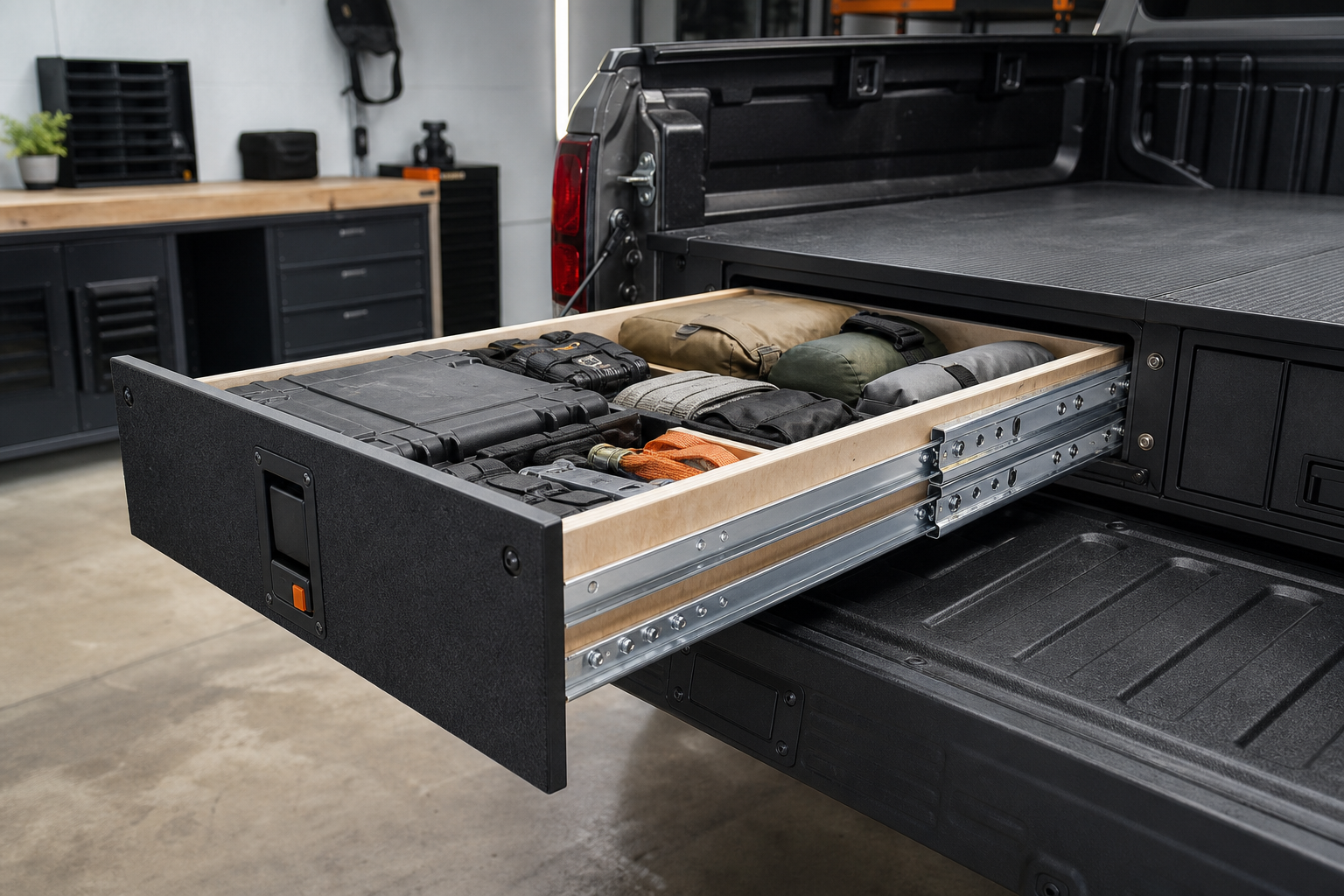
For a kitchen drawer with utensils, a properly rated standard or concealed runner may be the better system. For a 40-inch truck drawer carrying recovery gear, the larger cross-section, full-extension structure, positive locks, frame stiffness, and vehicle-use conditions matter more than quiet closing or hidden hardware.
Comparison matrix
Compare the application demands before comparing price.
| Decision | Standard cabinet slide | Heavy-duty slide |
|---|---|---|
| Typical moving load | Household drawer contents, light tools, compact organizers | Large tool drawers, equipment trays, vehicle storage, generators, batteries, fridge trays |
| Typical structure | Cabinet carcass and conventional drawer box | Rigid plywood, steel, or aluminum frame designed around the rail pair |
| Travel | Partial or full extension; soft-close often available | Full extension is common; over-travel or locking variants may be available |
| Position control | Usually non-locking, detent, self-close, or soft-close | May include lock-in, lock-out, paired releases, or custom linkage provisions |
| Cross-section | Smaller profile and less side-space consumption | Larger and thicker members that require more side and vertical space |
| Vehicle use | Do not assume suitability | Some models publish mobile conditions; many still require exact application review |
| Installation tolerance | Precise alignment remains important | Large loads and long drawers magnify small frame and clearance errors |
| Cost and weight | Lower hardware weight and usually lower cost | Higher material, shipping, frame, and installation cost |
Rating conditions
A load rating is incomplete without the test configuration.
Manufacturers generally test slides as a pair in a controlled fixture with defined drawer width, load distribution, mounting orientation, extension position, and cycle count. A published rating does not automatically include a wider drawer, front-concentrated cargo, horizontal mounting, flexible plywood frame, incorrect fasteners, or vehicle shock.
Use How to Choose Drawer Slide Load Rating to calculate the complete moving load and document the conditions.
When heavy-duty is justified
Choose it when multiple demands increase together.
Weight is the obvious signal, but it is not the only one. A long drawer with a moderate payload can need heavy-duty rails because extension leverage, width, and frame movement become difficult to control. A vehicle drawer may need a heavy-duty locking product even when the static payload is below the rating of a standard cabinet slide. A generator or fridge tray may need a robust frame and positive open-position control for service access.
- The complete moving assembly exceeds the exact standard-slide rating or leaves too little practical margin.
- The drawer is unusually long, wide, or front-heavy.
- The tray travels in a truck, RV, trailer, van, or mobile workstation.
- Lock-in and lock-out are required as part of normal use.
- The frame is intentionally built around large vertical mounting faces.
- The drawer must support dense equipment, tools, batteries, a fridge, or a generator.
- Inspection and service access matter more than concealed appearance.
When standard is better
More steel is not automatically a better cabinet.
A standard slide can be easier to fit, quieter, lighter, and better matched to daily interior cabinetry. Large heavy-duty rails consume drawer width and vertical space, require stronger mounting faces, add opening force and hardware weight, and may expose locking levers that are unnecessary in a level stationary cabinet.
Choose a normal cabinet runner when the load is known, the drawer is within the specified width and length, vehicle restraint is not needed, and features such as soft-close, concealed mounting, easy drawer removal, and compact profile matter more. Do not overspecify the rail while leaving the cabinet walls, shelf panel, screws, or drawer joints unchanged; the surrounding structure still controls system performance.
COREAX product examples
Use the family and selected size, not one brand-wide capacity.
Whole-system cost
Count the frame, lost space, fasteners, and installation time.
Heavy-duty rails can cost more to buy and ship, but the larger cost may be the structure required to use them correctly. A wide truck drawer needs straight mounting faces, a stiff drawer box, suitable fasteners, access around the release, and room for two thick rails. A custom linkage adds fabrication and testing. A standard cabinet system can require more precise drawer construction but may save width and weight.
Compare the completed system rather than only the slide pair. Rebuilding a drawer because the side space, length, or lock access was wrong is more expensive than choosing the correct duty class at the beginning.
Pre-order worksheet
Answer these questions before upgrading to heavy-duty.
- 01What is the complete moving weight?
Include the drawer, tray, face, handles, dividers, equipment, and maximum cargo.
- 02How wide and long is the drawer?
Record both geometry values because racking and length can change the applicable rating.
- 03Is the use stationary or mobile?
Do not apply a cabinet rating to a vehicle without supporting documentation or application guidance.
- 04Which positions need control?
Decide whether the build needs a detent, separate latch, lock-in, lock-out, or both.
- 05Can the frame carry the rail pair?
Confirm side space, vertical profile, mounting material, fastener access, and parallelism under load.
Evidence and testing context
Duty labels sit on top of model-specific test methods.
Manufacturer sourcesAccuride explains that load testing uses a mounted test fixture, distributed load, cycle checks, deflection measurement, full-extension static testing, and impact testing. Its heavy-duty terminology article also notes that mounting orientation and mobile use affect applicable capacity. These sources support evaluating duty class through test conditions rather than a universal label.
- Accuride: How Drawer Slide Load Ratings Are DeterminedManufacturer explanation of fixture, distributed load, cycle, static full-extension, deflection, and impact testing.
- Accuride: What Is a Heavy-Duty Drawer Slide?Manufacturer discussion of heavy-duty applications, mobile-use reductions, and mounting effects.
Evidence boundary: Accuride test descriptions and product examples do not certify COREAX products. COREAX specifications above come from current catalog data. Treat family maximums as selection starting points and verify the exact variation, frame, fasteners, orientation, and intended use.
COREAX product path
Choose the smallest system that fully satisfies the job.
Start with the heavy-duty selection guide when vehicle use, positive locks, long travel, or large moving loads are present. Choose LD2053 for integrated one-side release or L2576 for longer, higher-rated, builder-linked applications. For compact bottom-supported cabinetry, compare the COREAX black bottom-mount family instead of defaulting to oversized side rails.
Common questions
Heavy-duty vs standard FAQ
What weight makes a drawer slide heavy-duty?
There is no single universal threshold. Compare the exact model’s rating, test conditions, length, width, orientation, travel, mobile use, and intended application.
Can I use heavy-duty slides in a normal kitchen cabinet?
You can when the cabinet is designed for their side space, profile, weight, fasteners, and opening force, but a compact soft-close or concealed runner is often a better fit for ordinary household drawers.
Are heavy-duty slides safer for every vehicle drawer?
Not automatically. The selected model must fit the mobile-use conditions, and the frame, fasteners, locks, cargo restraint, and drawer construction must all be appropriate.
Why does a longer heavy-duty slide sometimes have a lower rating?
Longer members and greater extension can increase deflection and leverage. Use the size-specific rating rather than the product family’s highest number.
Reframed duty class around application and test conditions, added full-system cost, current COREAX size-specific examples, pre-order worksheet, manufacturer sources, and evidence boundaries.
Move to the next decision.
Use the next guide in the same planning path, then verify the exact product before ordering.