
RV Fridge And Camper Tray Planning
Drawer slides for RV fridge trays and camper pull-outs.
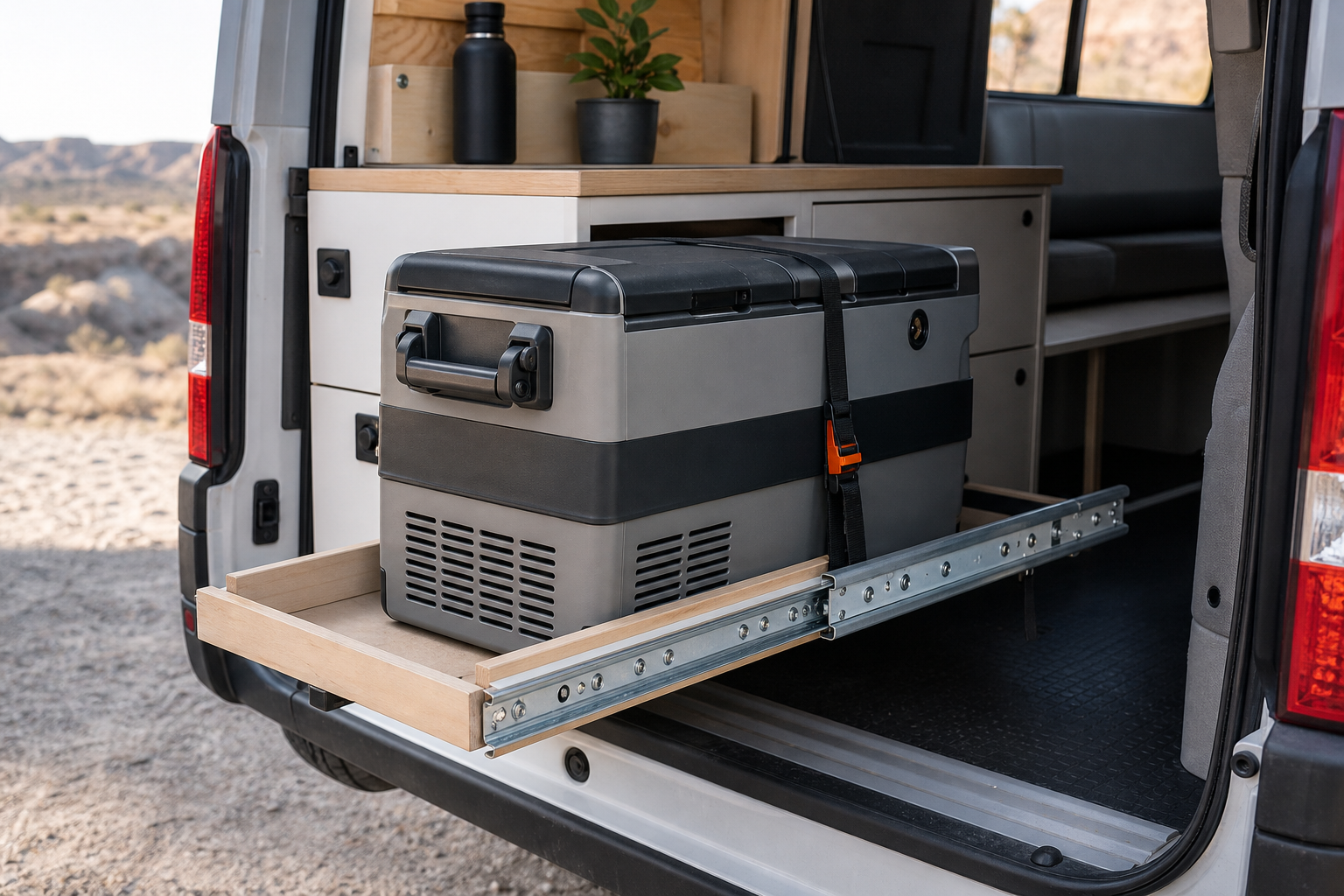
Choose fridge, cooler, camp-kitchen, griddle, and equipment tray slides by complete moving weight, concentrated-load position, required travel, lid and door clearance, ventilation, cable or hose movement, lock-in/out, compartment structure, and service access. The appliance and tray must be planned as one moving system.
- Published by
- COREAX
- Technical review
- COREAX Product Support
- Published
- Updated
Direct answer
Start with the appliance operating envelope, then choose the slide.
Measure the fridge or equipment at its heaviest operating condition, including contents, baskets, battery, tray, tie-downs, handles, and cables. Define how far it must move before the lid, door, vent, controls, service panel, or cooking surface can be used. Choose a side-mount full-extension locking slide for larger mobile trays when the frame provides rigid vertical mounting faces. Use a lighter bottom-supported system only for an interior cabinet pull-out within its documented load and travel conditions.
For most mobile fridge or cooler trays, closed travel restraint and open-position stability are valuable. Lock-in helps keep the tray closed during travel; lock-out helps keep it extended while loading. Neither replaces appliance tie-downs, cargo restraint, ventilation, or a correctly attached frame.
Tray types
Fridges, coolers, kitchens, and equipment load the tray differently.
| Pull-out type | Primary load pattern | Travel requirement | Additional checks |
|---|---|---|---|
| Portable fridge or freezer | Concentrated appliance mass plus changing food/liquid load | Lid/door and control access outside the compartment | Ventilation, power-cable travel, tie-downs, drain access |
| Cooler tray | Dense liquids and ice; weight changes during use | Enough extension to open lid and lift contents | Drain routing, wet cleanup, corrosion, tie-down points |
| Camp-kitchen tray | Distributed boxes plus concentrated stove/water items | Clear tailgate/door and create a usable work zone | Heat, windscreen, fuel lines, utensil retention, food-safe cleaning |
| Griddle or stove tray | Concentrated appliance load and user interaction at the front | Clear combustible surfaces and enclosure | Heat shielding, gas hose, grease, ventilation, manufacturer clearances |
| Generator or battery tray | Very dense equipment, vibration, service force | Full service access outside the bay | Exhaust/heat, cable strain, fuel, ventilation, grounding, qualified installation |
| General cargo bin | Variable and potentially unbalanced contents | Access to rear contents | Dividers, tie-downs, load shift, drawer face restraint |
Complete moving load
Use the heaviest realistic operating condition.
Liquids, ice, batteries, cast-iron cookware, tools, and fuel containers can add weight faster than visual volume suggests. The tray may also become front-heavy during use when the appliance lid is open, the user pulls from one corner, or heavy items are placed on the extended work surface.
Use the drawer-slide load-rating guide to keep the rating attached to length, width, orientation, distribution, and mobile-use conditions.
Operating envelope
Measure the open appliance, not only the closed box.
The fridge can physically fit in the compartment and still be unusable. Top-opening appliances need vertical and rear lid-swing clearance. Front-opening units need door swing and standing space. Controls may sit at the end that remains under a countertop. Vent grilles can be blocked by a drawer face or compartment wall.
- Closed appliance width, depth, and height.
- Open lid or door height, radius, and handle projection.
- Control-panel visibility and hand access.
- Vent intake and exhaust areas required by the appliance manufacturer.
- Power plug, cable bend radius, hose, drain, or gas-line movement.
- Space for baskets, contents, and lifting items vertically.
- Service-panel and compressor access without removing the complete vehicle interior.
Ventilation and temperature
The tray must preserve the appliance’s specified airflow.
Refrigerator and cooler designs use different cooling systems and ventilation patterns. An absorption refrigerator, compressor fridge, chest cooler, battery, generator, and stove cannot share one generic airflow rule. Follow the exact appliance installation manual. Do not assume that sliding the appliance out during use compensates for blocked ventilation while closed or during travel.
Dometic notes that venting, installation, clearance, and airflow are imperative for absorption refrigerator operation. Other compressor appliances publish their own intake, exhaust, and enclosure requirements. Keep vents clear of drawer faces, tie-down straps, cables, insulation, and stored gear. If a fan or duct is added, make sure it does not interfere with tray travel or service.
Power, cable, hose, and drain movement
Design a controlled service loop.
A cable that reaches the closed appliance may become tight at full extension. A loose cable can fall into the slide. A hose can kink, rub on a metal edge, or carry force into a connector. Plan the route through the complete travel and protect it from heat, sharp edges, pinch points, lock levers, and cargo.
Travel and cargo restraint
Control the tray, the appliance, and the contents separately.
Lock-in controls the slide’s closed end position. The appliance still needs suitable attachment to the tray. The tray contents may need dividers or straps. The completed compartment may need an additional latch according to vehicle use and applicable requirements. Do not rely on the refrigerator’s own door latch to secure the appliance to the tray.
COREAX slide choice
Choose by load, length, profile, and release method.
| Product path | Best fit | Key checks |
|---|---|---|
| LD2053 | Portable fridge, cooler, camp-kitchen, and moderate heavy-duty trays in 12–40 inch sizes | Applicable up-to-265-lb specification, approximately 19 mm side space per rail, integrated single-side release, lock handle access |
| L2576 | Longer or heavier custom fridge, battery, generator, equipment, and cargo platforms in 20–60 inch sizes | 76 mm vertical profile, size-specific 476–291 lb pair ratings, approximately 19 mm side space per rail, builder-supplied linkage |
| Black bottom-mount slides | Light interior cabinet trays and shelf-style pull-outs within 10–20 inch range | Up-to-88-lb family specification, soft-close, solid bottom support, separate vehicle latch when required |
| Pull-out worktop kit | Supported prep surface rather than an appliance cargo tray | 110 lb working-load claim, top/concealed bottom mounting, shorter travel than rail length, extended-position latch only |
Tray and frame
The appliance base must stay flat at full extension.
A heavy appliance on a thin plywood tray can sag between the slides. The front can drop, changing rail alignment and lid level. Use a tray structure that distributes concentrated feet or base rails. Tie-down points should connect into the tray frame rather than only a thin surface skin. Both slide mounting faces must remain parallel under the complete load.
- Support concentrated appliance feet or base rails.
- Prevent tray torsion when the user pulls from one corner.
- Keep slide fasteners clear of the moving members.
- Protect wood edges and metal cuts from moisture and corrosion.
- Allow cleaning below and around the appliance.
- Provide a removal path for service or replacement.
- Test with the real appliance and representative contents.
Failure modes
What goes wrong after the tray is loaded.
Pre-travel inspection
Use a repeatable checklist before the first trip.
- 01Cycle empty
Confirm complete closed/open lock engagement, release access, and no cable contact.
- 02Add the appliance
Check tray flatness, tie-downs, feet support, and service access.
- 03Add representative contents
Recheck opening force, frame movement, front drop, cable loop, and lock alignment.
- 04Operate the appliance fully
Open lid or door, use controls, connect power, and verify ventilation at the intended open and closed conditions.
- 05Secure for travel
Engage slide lock, external latch if used, appliance tie-downs, internal cargo control, and compartment door.
- 06Inspect after initial travel
Look for fastener movement, rubbed cables, loose tie-downs, metal dust, water paths, and changed lock engagement.
Evidence and appliance boundary
Slide selection cannot replace appliance installation requirements.
Manufacturer sourcesDometic states that ventilation, installation, clearance, and airflow are imperative for absorption-refrigerator operation. Accuride’s 9300 family shows separate stationary/mobile conditions and lock-in/out variants for vehicle compartments. Together, these sources support treating appliance airflow and mobile slide restraint as separate required systems.
- Dometic Refrigerator Installation DifferencesOfficial support guidance emphasizing ventilation, installation clearance, and airflow for the specified refrigerator type.
- Accuride 9300 SeriesOfficial mobile/stationary examples and lock-in/lock-out variants for vehicular compartments.
Evidence boundary: Follow the exact appliance manual; Dometic’s cited requirements are not universal to every cooler or compressor fridge. Accuride ratings do not certify COREAX products. COREAX specifications above come from current catalog data, and the completed tray must be validated for the real appliance and vehicle.
COREAX product path
Send the appliance and compartment dimensions before choosing length.
Choose LD2053 for a ready integrated one-side release in the applicable size and load range. Choose L2576 for longer or heavier custom frames with a validated linkage. For support, provide appliance model, closed and open dimensions, total working load, compartment depth and width, required travel, mounting material, cable or hose route, and intended vehicle use.
Common questions
RV fridge tray FAQ
What type of drawer slide is best for an RV fridge tray?
A side-mount full-extension slide with applicable load and mobile-use conditions plus closed/open restraint is a strong starting point for larger trays. The exact choice depends on appliance weight, tray, length, width, frame, ventilation, cable travel, and lid clearance.
Should a fridge tray lock open and closed?
Both functions are useful in many RV and camper installations: lock-in controls travel, and lock-out stabilizes the open tray. The appliance still needs its own tie-down, and the complete system may need an external latch.
How much extension does a top-opening fridge need?
Enough to clear the compartment obstruction and allow the lid to reach its required open position with hand and content access. Measure the actual lid arc and use the exact slide travel.
Can the power cable simply hang behind the tray?
No. Provide a controlled service loop or suitable carrier that reaches full extension without tension and cannot enter the rails, locks, sharp edges, or heat sources.
Absorbed camper tray planning and added tray-type matrix, complete-load calculation, appliance operating envelope, ventilation, cable/hose routing, layered restraint, current COREAX choices, failure modes, pre-travel inspection, sources, and FAQ.
Move to the next decision.
Use the next guide in the same planning path, then verify the exact product before ordering.