
RV Storage Hardware Hub
Hardware for RV storage builds.
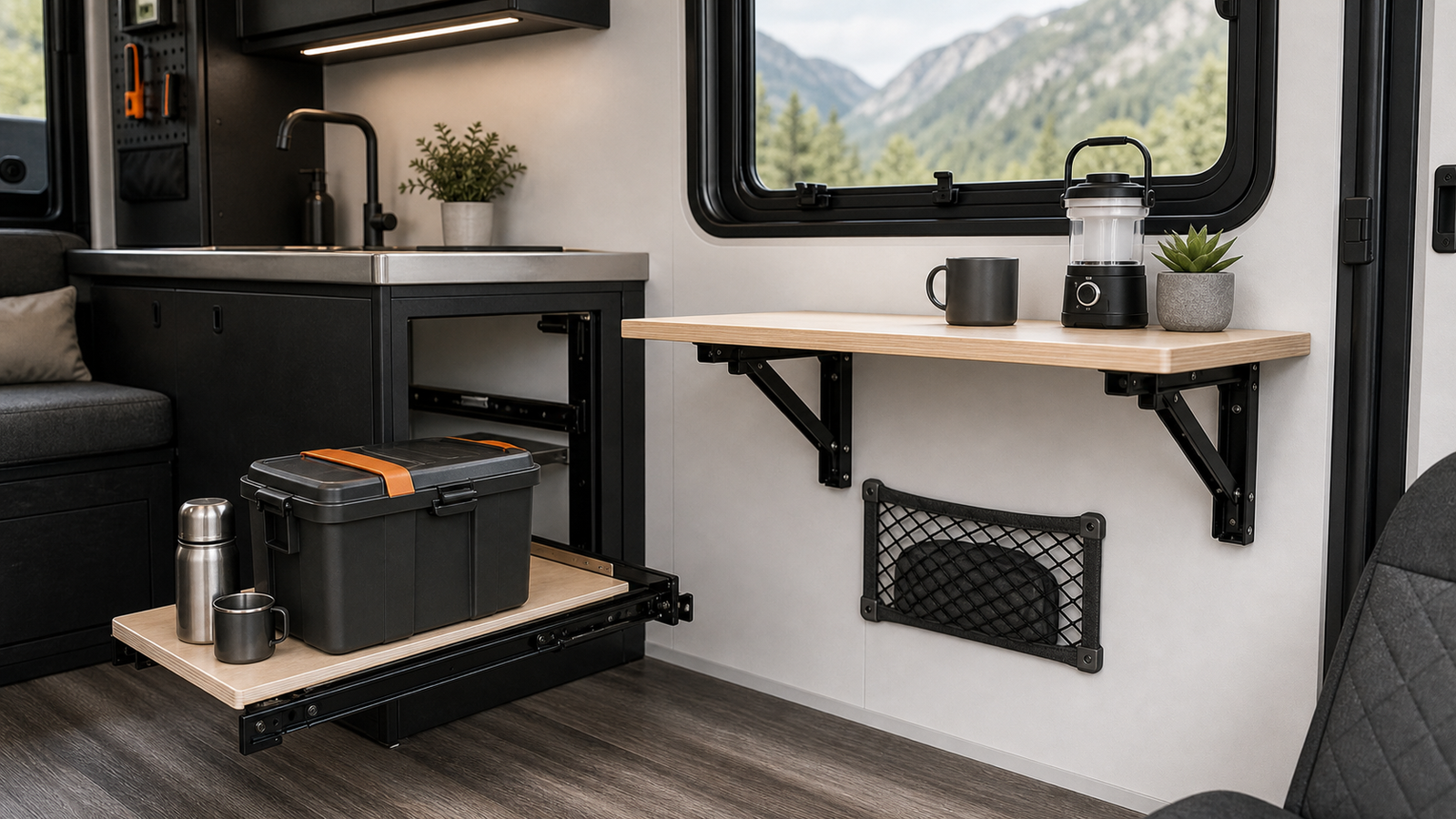
RV storage hardware must balance vehicle motion, limited space, lightweight structure, service access, quiet interior use, ventilation, plumbing and wiring, and positive travel restraint. Choose different hardware for exterior equipment trays, interior cabinet pull-outs, fridge platforms, fold-down tables, and fixed safety-critical components.
- Published by
- COREAX
- Technical review
- COREAX Product Support
- Published
- Updated
Direct answer
Separate exterior/mobile trays from interior cabinet storage.
Use heavy side-mount locking slides for larger exterior cargo, fridge, generator, battery, and service trays when the RV structure provides adequate vertical mounting faces and the selected slide conditions fit. Use lighter bottom-supported or concealed runners for interior pantry, galley, wardrobe, and vanity pull-outs. Use folding brackets only where adequate backing carries the load and a separate restraint holds the surface during travel.
Soft-close, hold-in detent, lock-in, lock-out, cabinet door latch, appliance tie-down, and compartment latch are different functions. An RV build often needs more than one layer.
RV zone map
Choose hardware according to location and consequence.
| RV zone | Typical storage | Hardware direction | Key risks |
|---|---|---|---|
| Exterior pass-through bay | Cargo bins, tools, camp equipment | Locking heavy-duty trays or fixed bins | Road vibration, water, dust, door clearance, long reach |
| Fridge or cooler bay | Portable fridge, freezer, cooler | Locking full-extension tray with appliance tie-down | Concentrated load, ventilation, cable travel, lid clearance |
| Generator/battery service bay | Dense electrical or mechanical equipment | Purpose-designed service tray or fixed mount with qualified system design | Heat, exhaust, electrical, fuel, grounding, extreme concentrated load |
| Galley cabinet | Cookware, pantry goods, appliances | Bottom-supported or concealed soft-close pull-outs plus travel latch | Hinge intrusion, liquids, heat, power cords, quiet daily use |
| Wardrobe/vanity | Clothing, toiletries, cleaning supplies | Compact runners, bottom-mount shelves, positive cabinet latch | Moisture, plumbing, bottle height, light panel construction |
| Dinette/bed conversion | Folding work or dining surface | Folding brackets and purpose-built furniture structure | Human interaction, egress, travel restraint, wall backing |
| Overhead cabinet | Light soft goods and small items | Door stays, latches, lightweight fixed shelves | Falling objects, head injury, weak ceiling/wall panels |
Hardware layers
Movement, closing feel, restraint, and cargo control are separate.
Exterior and mobile trays
Use positive control and a rigid frame.
Exterior trays experience road vibration, compartment flex, dirt, water, and changing loading. A large drawer must remain closed during travel and often remain open while loading. Full extension improves access through a deep bay, but it also places the load farther from the frame.
- Calculate tray, face, hardware, appliance, and maximum cargo weight.
- Verify the selected slide length and applicable mobile-use conditions.
- Measure side clearance at the front, middle, and rear.
- Provide lock-in and lock-out or suitable alternative restraints.
- Keep release levers or linkage accessible through the bay opening.
- Use corrosion-appropriate hardware and protect cut edges.
- Preserve bay-door seals, drains, factory fasteners, and service access.
- Retest locks and fasteners after initial road use.
Interior cabinet pull-outs
Compact profile and quiet closing may matter more than high capacity.
Interior RV cabinets are often made from lightweight panels and face frames. The clear opening can be much narrower than the cabinet interior because hinges, door overlays, trim, plumbing, and wiring intrude. A bottom-supported shelf or concealed runner can preserve side visibility and provide soft-close movement, but the drawer or shelf must match the exact system.
Absorbing the former RV cabinet pull-out topic into one selection framework: use RV Storage Drawer Slide Guide to compare exterior/mobile side-mount trays with interior cabinet runners. Do not install a high-capacity rail on thin decorative paneling and assume the cabinet is upgraded.
Fridge and cooler trays
Follow the appliance operating envelope.
Measure the appliance with its lid or door open, contents loaded, cables connected, vents unobstructed, and service panels accessible. Do not treat every RV refrigerator as a portable chest fridge. Absorption, compressor, drawer, and cooler products have different installation and airflow requirements.
Use Drawer Slides for RV Fridge Trays for the complete-load worksheet, lid and door travel, ventilation, cable routing, tie-downs, and pre-travel inspection.
Folding tables and work surfaces
The wall structure and travel restraint control the installation.
RV wall panels can be thin finishes over wood, aluminum, or composite framing. Mounting a folding bracket only to the visible panel may not create a safe load path. Find or install adequate backing and follow the RV manufacturer’s constraints before drilling. The shelf board, bracket spacing, fasteners, wall structure, and front-edge load determine finished capacity.
- Confirm structural backing behind both brackets.
- Choose bracket length for shelf depth and front overhang.
- Keep the release reachable without pinching fingers against cabinetry.
- Check the folded panel against seats, doors, windows, and egress paths.
- Use a positive travel restraint independent of the bracket hinge.
- Follow stove, heater, electrical, and combustible-clearance requirements.
- Do not use ordinary shelf brackets as seating or sleeping support without purpose-designed engineering.
COREAX product map
Match the product family to the RV zone.
| COREAX family | RV use | Important limits |
|---|---|---|
| LD2053 heavy-duty locking slides | Exterior cargo drawers, fridge/cooler trays, camp-kitchen and equipment pull-outs | 12–40 in, side mount, approximately 19 mm side space per rail, integrated single-side release, up-to-265-lb family claim subject to selected variation and system |
| L2576 76 mm locking slides | Longer and heavier service trays or custom cargo platforms | 20–60 in, 76 mm profile, size-specific 476–291 lb pair rating, builder-supplied linkage, substantial vertical mounting faces |
| Black bottom-mount slides | Interior pantry, vanity, wardrobe, and utility shelf pull-outs | 10–20 in, up to 88 lb family capacity, soft-close, non-detachable, solid bottom support, separate travel latch where required |
| Folding shelf brackets | Fold-down table, prep shelf, laundry shelf, or temporary work surface | 8–16 in sizes, wall backing required, shelf/fasteners/spacing control finished capacity, separate travel restraint |
| Pull-out worktop kit | Supported compact desk or prep-surface extension | 12–20 in rails, up to 110 lb working-load claim, top or concealed bottom layout, latch holds extended position only |
RV fit worksheet
Record the constraints before selecting a product.
Common RV mistakes
What makes a storage upgrade unsafe or unusable.
Build sequence
Prototype the RV movement before finishing the cabinetry.
- 01Review RV and equipment documentation
Locate structure, utilities, payload limits, appliances, service access, and prohibited modification zones.
- 02Measure the complete operating envelope
Open doors, lids, beds, seats, hatches, and tables while marking user standing space.
- 03Choose hardware by zone
Separate exterior locking trays, interior pull-outs, fixed modules, and fold-down surfaces.
- 04Build a serviceable frame
Provide backing, fastener access, rail parallelism, utility protection, and removal paths.
- 05Test empty and loaded
Verify full travel, locks, latches, soft-close, cables, ventilation, and furniture conflicts.
- 06Inspect after initial travel
Retorque or correct only according to the joint design; document movement and recurring maintenance.
Evidence and product boundary
Cabinet runners and vehicle slides publish different instructions.
Manufacturer sourcesAccuride’s 9300 family publishes heavy-duty, full-extension, lock, and mobile/stationary conditions for vehicle-style compartments. Blum publishes model-specific assembly instructions for concealed cabinet runners. These sources demonstrate why an RV exterior tray and an interior soft-close cabinet should not be specified through one generic slide category.
- Accuride 9300 SeriesOfficial heavy-duty mobile/stationary and lock-in/out product-family example.
- Blum Runner Assembly InstructionsOfficial exact-kit instructions for concealed interior cabinet runners.
Evidence boundary: External product data does not certify COREAX hardware or an RV modification. Follow the RV, appliance, and equipment manufacturers, applicable electrical/gas/building rules, and qualified professional guidance where necessary. COREAX specifications apply only to the selected products and stated conditions.
COREAX fit support
Send the RV zone, structure, and travel requirement.
For product guidance, provide the storage location, opening width and depth, moving load, mounting structure, selected equipment, stationary or mobile tray type, required lock positions, and photos showing hinges, utilities, and the complete travel path.
Common questions
RV storage hardware FAQ
What drawer slides are best for RV storage?
Use heavy locking side-mount slides for larger exterior/mobile trays and suitable bottom-supported or concealed runners for lighter interior cabinet pull-outs. Verify the exact load, length, structure, restraint, and operating conditions.
Is soft-close enough to keep an RV drawer closed while driving?
No. Soft-close controls final closing speed. Use a positive travel latch, lock-in slide, or another suitable restraint for vehicle movement.
Can folding brackets mount directly to an RV wall panel?
Not by assumption. Identify adequate structural backing and confirm the RV manufacturer permits attachment in that location. The visible panel alone may not carry the load.
Should all heavy RV equipment be placed on slide trays?
No. Fixed mounting can be lighter, stronger, and safer for batteries, water, fuel, or safety-critical equipment. Use a slide only when service/access benefits justify the added weight and moving connections.
Rebuilt the page as an RV hardware hub, absorbed cabinet-pull-out constraints, separated exterior and interior zones, added layered restraint, product map, fit worksheet, build sequence, sources, evidence boundary, and FAQ.
Move to the next decision.
Use the next guide in the same planning path, then verify the exact product before ordering.