
Drawer Position Control
Locking vs non-locking drawer slides.
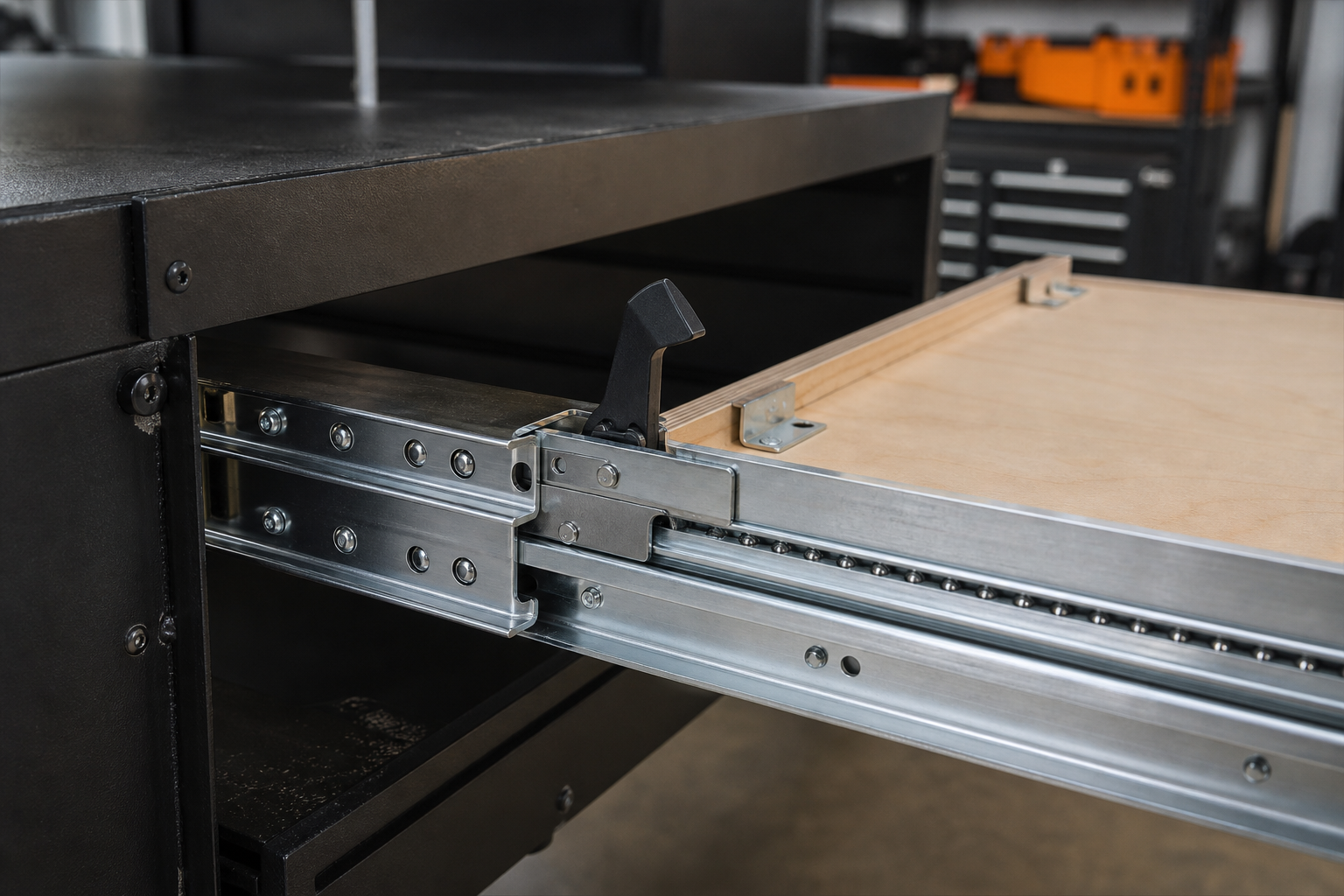
Choose locking slides when the drawer must remain positively controlled while closed, fully extended, or both. Choose non-locking slides when the installation is stationary, level, separately latched if necessary, and does not require the slide itself to hold an end position.
- Published by
- COREAX
- Technical review
- COREAX Product Support
- Published
- Updated
Direct answer
Choose by the uncontrolled movement you need to prevent.
A locking slide is useful when gravity, vibration, braking, uneven ground, or the user’s force could move the drawer unexpectedly. Lock-in controls the fully closed position. Lock-out controls the fully extended position. A model can provide one, both, or neither. A non-locking slide may still be correct when the cabinet is stationary and level, the drawer does not need to remain open, or a separate latch provides the required closed restraint.
Do not use “locking” as a substitute for a complete safety analysis. The lock does not strengthen a weak frame, stop cargo from shifting inside the drawer, create intermediate positions, or make the drawer suitable as a step or seat.
Control levels
Separate a detent, soft-close, external latch, and positive slide lock.
| Mechanism | What it does | What it does not prove | Typical use |
|---|---|---|---|
| Non-locking slide | Provides guided movement and the specified travel | Does not hold closed or open against vehicle motion or slope | Level stationary cabinets |
| Hold-in detent | Adds resistance near the closed position | Is not automatically a positive travel lock | Tool carts, trays, or cabinets with modest roll-out control |
| Soft-close | Slows the final closing movement | Does not provide vehicle restraint or lock-out | Kitchens, pantries, vanities, interior cabinetry |
| External latch | Secures the completed drawer or door in a chosen position | Does not hold the slide open unless designed for that purpose | Vehicle drawers using non-locking slides |
| Lock-in | Positively controls the fully closed slide position until released | Does not imply lock-out or intermediate locking | Truck, RV, trailer, and mobile storage |
| Lock-out | Positively controls the fully extended position until released | Does not level the vehicle or support human loads | Fridge trays, service trays, work surfaces |
When locking slides are the better choice
Use them when the slide must control an end position as part of normal operation.
Vehicle storage is the clearest case. A drawer can experience acceleration, braking, cornering, road vibration, chassis angle, and uneven parking. A positive closed lock reduces reliance on friction or a light detent. When the drawer is extended, an open-position lock can keep a fridge, generator, tool tray, or kitchen module from rolling back while it is being used.
Locking slides also help stationary applications where the mounting surface is not consistently level or where the open tray must resist accidental retraction. Examples include service carts, industrial equipment, keyboard or control trays, and heavy work surfaces. The need is functional rather than purely load-based: a light tray on a slope may need a lock, while a heavy level cabinet may not.
- The drawer travels in a truck, RV, trailer, van, boat, or rolling equipment.
- The tray supports an appliance or equipment that must remain accessible while open.
- The user cannot hold the tray with one hand while loading or servicing it.
- The installation can be parked or used on a slope.
- The system requires a deliberate release rather than friction resistance.
When non-locking slides make sense
Do not add a lock mechanism when the system does not need one.
A normal kitchen drawer, pantry shelf, vanity organizer, desk drawer, or stationary garage cabinet often works well without a slide lock. Non-locking slides can reduce handle clearance requirements, eliminate release coordination, simplify drawer removal, and offer features such as soft-close. When only the closed position needs restraint, a purpose-designed external latch may be easier to inspect and replace than a locking slide mechanism.
The important condition is that movement remains controlled in the real installation. A “stationary” drawer mounted in a rolling cart is not stationary. A soft-close runner in an RV is not automatically travel-secured. A cabinet mounted slightly out of level can allow a heavy drawer to drift even without vehicle motion.
Release access
The lock is only useful when the user can release it after the drawer is finished.
Traditional paired locking slides may require both levers to move at the same time. That can be practical on a narrow drawer with exposed sides and frustrating on a deep truck drawer. Integrated single-side release solves this by transferring the release function across the slide pair. A linkage-ready system leaves the builder responsible for connecting both levers with a bar, rod, cable, or other mechanism.
Review Single-Side Release Drawer Slides before choosing a release architecture.
COREAX examples
Two locking families solve different release problems.
Before ordering
Check the lock function together with the fit.
- 01Define the required positions
Closed only, open only, both ends, or an intermediate stop. Do not assume one function implies the others.
- 02Define the release user
Where will the person’s hand be after the drawer face, trim, cargo, and surrounding structure are installed?
- 03Measure the mechanism envelope
Allow side space, lever swing, linkage movement, handle clearance, and access for installation and service.
- 04Verify the load and orientation
The locking function does not override the selected slide’s load, length, width, mobile-use, and mounting conditions.
- 05Test both positions under gradual load
Confirm complete engagement, deliberate release, no partial latch contact, and no frame movement before road or field use.
Evidence and terminology
Manufacturers publish detents and locks as different features.
Manufacturer sourcesAccuride lists the 9308E as a lock-in and lock-out model that secures vehicular compartments in open and closed positions. Its 3600AD is described separately as a full-extension slide with a customizable hold-in detent. These examples support the distinction between positive end-position locking and added closed-position resistance.
- Accuride 9300 SeriesOfficial lock-in/lock-out variants, full-extension terminology, and mobile versus stationary examples.
- Accuride 3600ADOfficial example of a hold-in detent described separately from a positive dual-end lock.
Evidence boundary: The cited functions and ratings apply only to the named Accuride products. COREAX product statements are based on the current COREAX catalog. A completed vehicle or equipment drawer may require additional latches, cargo restraint, engineering review, or compliance with applicable regulations.
COREAX product path
Choose the release architecture, not only the lock label.
Choose LD2053 when one-side operation should be integrated into the slide pair. Choose L2576 when the build needs a longer or heavier slide and the installer can fabricate and validate a custom release linkage. Use a non-locking or soft-close system only when the application does not require the slide to provide positive end-position control, or when a suitable external latch handles that function.
Common questions
Locking vs non-locking FAQ
Do truck bed drawers always need locking slides?
They need reliable restraint, but that can come from locking slides or a correctly designed external latch used with non-locking slides. The system must also control cargo and remain secure under vehicle motion.
Is a hold-in detent the same as lock-in?
No. A detent adds resistance near a position. A positive lock normally requires deliberate release. Use the exact model documentation rather than treating the terms as interchangeable.
Can soft-close slides be used in an RV?
They can be used for suitable interior cabinetry, but soft-close is not automatically a travel latch. Add an appropriate closed restraint when vehicle movement could open the drawer.
Do locking slides lock at halfway positions?
Most lock-in/lock-out slides control the fully closed and fully extended positions only. Use an explicitly specified multi-position mechanism or a separate stop if an intermediate position is required.
Separated detent, soft-close, external latch, lock-in, and lock-out functions; added release-architecture decisions, COREAX family examples, manufacturer sources, and installation boundaries.
Move to the next decision.
Use the next guide in the same planning path, then verify the exact product before ordering.