
RV Drawer Slide Selection
How to choose drawer slides for RV storage.
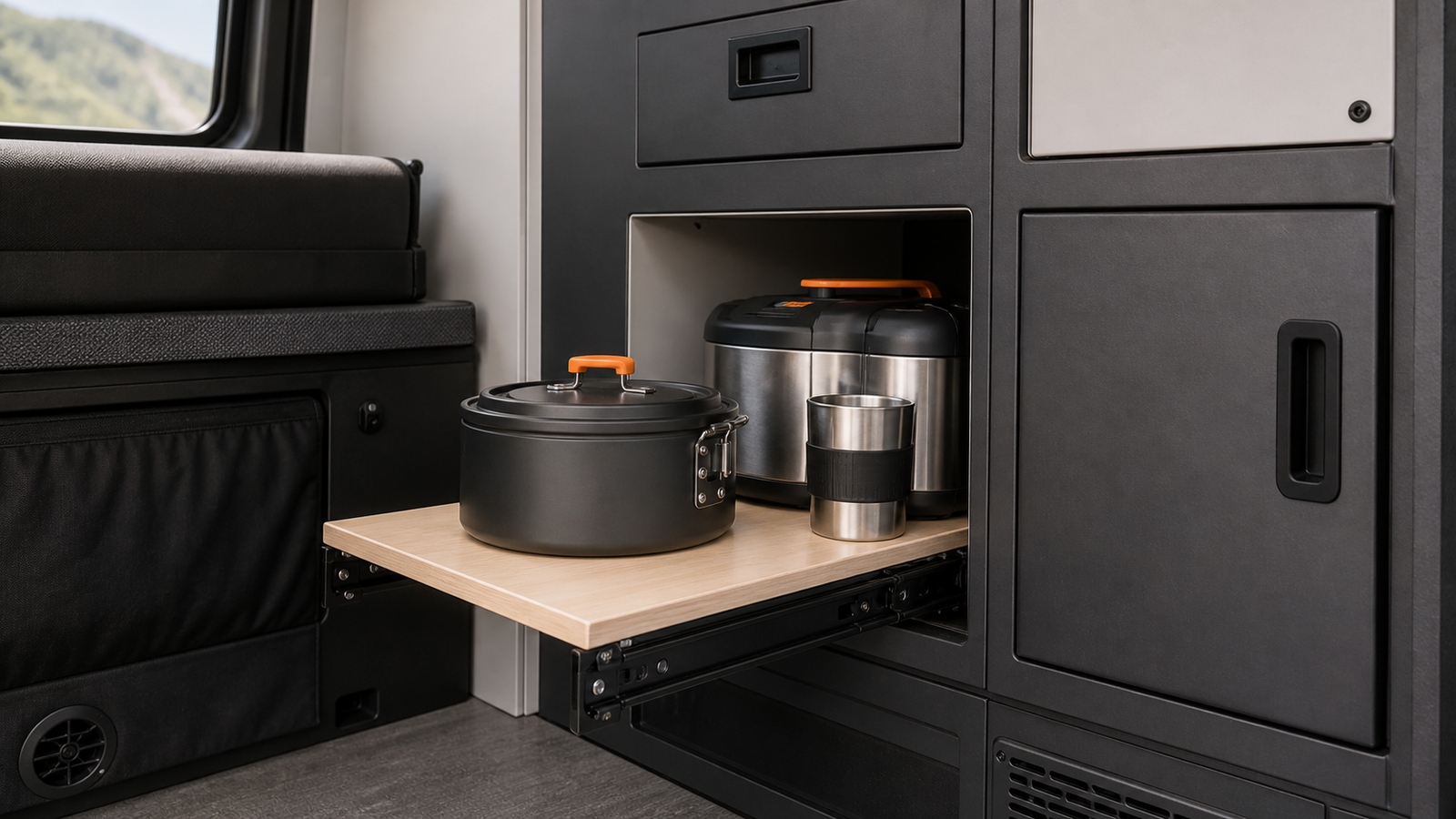
Separate exterior equipment trays from interior cabinet pull-outs before choosing a slide. Exterior and mobile trays need documented load conditions, rigid frames, positive travel restraint, weather planning, and service access. Interior cabinets usually prioritize compact profile, soft-close movement, quiet operation, and a separate travel latch.
- Published by
- COREAX
- Technical review
- COREAX Product Support
- Published
- Updated
Direct answer
Choose one of three RV slide paths.
Use heavy side-mount locking slides for exterior cargo, fridge, generator, battery, and equipment trays when the RV provides adequate vertical mounting faces and the exact selected-size conditions fit. Use bottom-supported or concealed cabinet runners for lighter pantry, galley, wardrobe, vanity, and utility pull-outs. Use a fixed shelf or fixed equipment mount when movement adds weight, cable complexity, or safety risk without enough access benefit.
This page absorbs the former RV cabinet-pull-out topic into a single decision system. The product category is chosen by location, complete moving load, mounting structure, required travel, restraint, and operating environment—not by the word “RV” alone.
Three product paths
Exterior tray, interior pull-out, or fixed storage.
| Path | Typical application | Primary hardware | Controlling checks |
|---|---|---|---|
| Heavy mobile tray | Pass-through cargo, fridge, cooler, generator, battery, outdoor kitchen, service equipment | Side-mount full-extension locking slides plus appliance/cargo restraint | Complete load, mobile conditions, rigid frame, lock-in/out, release access, weather, utilities |
| Interior cabinet pull-out | Pantry, cookware, wardrobe, vanity, laundry, cleaning supplies, small appliance shelf | Bottom-supported or concealed runners plus positive travel latch | Clear opening, hinge intrusion, shelf/drawer construction, soft-close, quiet movement, lightweight cabinet structure |
| Fixed storage or equipment | Water, battery, fuel, electrical distribution, rarely accessed cargo | Fixed brackets, straps, enclosure, service panel | Payload, safety, heat, ventilation, wiring/plumbing, qualified installation, service removal |
Location first
The same drawer can require different hardware in a different RV zone.
Complete moving load
Count the drawer, not only the stored items.
Liquids, canned food, cast-iron cookware, batteries, tools, cleaning products, and appliances create concentrated loads. A cabinet can also flex more than the drawer. Verify that the RV cabinet or frame can transfer the load into adequate structure instead of relying on thin decorative paneling.
Opening and depth worksheet
Measure the clear path after hinges, seals, trim, and utilities.
| Measurement | Method | Why it matters |
|---|---|---|
| Clear door opening | Measure between hinges, face frame, seal, latch, and door edge | Determines whether the drawer face and loaded shelf can pass |
| Usable depth | Measure both sides at planned rail height to the nearest rear obstruction | Sets maximum closed slide length |
| Opening width front/middle/rear | Use the narrowest value | Controls side-mount drawer width or bottom-runner spacing |
| Vertical opening | Include shelf thickness, runner profile, bottle/appliance height, and door swing | Determines usable storage and service access |
| Utility intrusion | Map pipes, wires, ducts, tanks, heater components, and service panels | Prevents damage and preserves repair access |
| Operating envelope | Open appliance lid/door, pull tray fully, and position user | Confirms required travel and clearance |
Exterior and heavy trays
Use a side-framed locking system when the structure supports it.
Heavy exterior trays benefit from full extension, positive lock-in, open-position lock-out, and a release that remains reachable through the bay opening. Both vertical rail faces must remain parallel under the complete load. The tray must control concentrated appliance feet and avoid sagging at full extension.
Use the RV fridge tray guide for appliance ventilation, cables, lid clearance, tie-downs, and pre-travel checks.
Interior cabinet pull-outs
Preserve cabinet space and add a real travel latch.
Interior drawers normally do not need the size, weight, and lever envelope of a heavy vehicle tray. A bottom-supported shelf can keep side edges open and suit compact pantry, trash, laundry, vanity, and appliance storage. A concealed undermount runner can provide a cleaner conventional drawer when the drawer box is prepared for the exact system.
- Do not mount runners only to thin decorative cabinet skin.
- Confirm the shelf or drawer bottom carries the fasteners and load.
- Keep hinges and door overlays outside the drawer path.
- Control bottles, cookware, and bins inside the drawer.
- Protect plumbing and wiring from moving hardware.
- Plan tool access because some bottom-mount assemblies do not disconnect.
Travel restraint
Choose a restraint for the completed drawer, not only the runner.
RV utilities and service
A drawer must not hide or damage the systems behind it.
Many RV cabinets contain wiring, plumbing, heating ducts, tanks, pumps, converters, batteries, or factory fasteners. Map them before choosing rail location. Provide grommets and controlled cable loops where movement is permitted. Keep drawer screws from entering hidden utilities. Preserve access panels and a removal path for the complete drawer.
Electrical, propane, fuel, structural, and appliance work can require qualified professionals and applicable codes. A storage slide does not authorize moving or enclosing these systems.
Noise, moisture, and temperature
Interior comfort and exterior exposure call for different details.
Decision flow
Choose the slide in seven steps.
- 01Classify the RV zone
Exterior mobile tray, interior cabinet, appliance pull-out, or fixed equipment.
- 02Calculate the complete moving load
Include drawer/shelf, face, hardware, equipment, and maximum contents.
- 03Measure the clear opening and rail path
Account for hinges, seals, trim, utilities, and service space.
- 04Confirm mounting structure
Identify real backing or frame rather than relying on visible paneling.
- 05Choose travel and restraint
Full extension, soft-close, lock-in/out, external latch, and cargo control are separate decisions.
- 06Protect utilities and operation
Check cables, hoses, ventilation, appliance lids, furniture conversion, and egress.
- 07Test and inspect after travel
Load gradually, verify latches, and recheck fasteners, frame movement, noise, and utility contact.
Common failures
What happens when an interior cabinet is treated like an exterior tray—or vice versa.
Evidence and application boundary
Vehicle slides and cabinet runners have different mounting and movement requirements.
Manufacturer sourcesAccuride’s 9300 family shows heavy-duty side-mount, lock, and mobile/stationary conditions appropriate to vehicle-style trays. Blum publishes exact-kit instructions for concealed cabinet runners. These examples support separating exterior mobile trays from interior cabinet pull-outs and following the exact hardware instructions.
- Accuride 9300 SeriesOfficial heavy-duty mobile/stationary and lock-variant example.
- Blum Runner Assembly InstructionsOfficial model-specific instructions for concealed interior cabinet runners.
Evidence boundary: External products do not certify COREAX products or an RV modification. Follow RV and equipment manufacturer instructions, applicable laws, and qualified professional guidance. COREAX specifications above apply only to the selected product and documented conditions.
COREAX product path
Send the storage zone and structure with the measurements.
Choose LD2053 for applicable exterior/mobile trays needing integrated single-side release. Choose L2576 for longer or heavier custom frames with a validated linkage. Choose COREAX black bottom-mount slides for suitable lighter interior shelf pull-outs, then add a travel latch where required.
Common questions
RV drawer slide FAQ
What is the difference between RV exterior and interior drawer slides?
Exterior/mobile trays generally need stronger frames, documented mobile conditions, positive restraints, weather planning, and service access. Interior cabinets often prioritize compact profile, soft-close, and a separate travel latch.
Can I mount heavy-duty slides to an RV cabinet wall?
Only when the wall or added frame provides adequate structural backing and the RV manufacturer permits attachment there. Decorative paneling alone may not carry the load.
Do bottom-mount slides need a travel latch in an RV?
Usually yes when vehicle movement can open the drawer. Soft-close or self-close is not automatically a positive closed restraint.
Should batteries or water tanks be placed on slide trays?
Not automatically. Fixed mounting can reduce weight, moving connections, and risk. Use a service tray only when the access benefit is justified and the complete system is designed for the equipment and vehicle.
Absorbed the RV cabinet pull-out topic and rebuilt the page around three storage paths, RV zones, complete load, opening/depth worksheet, exterior and interior product boundaries, restraint, utilities, environment, seven-step decision flow, sources, and FAQ.
Move to the next decision.
Use the next guide in the same planning path, then verify the exact product before ordering.