
Truck Drawer Slide Decision
Best drawer slides for truck bed drawers.
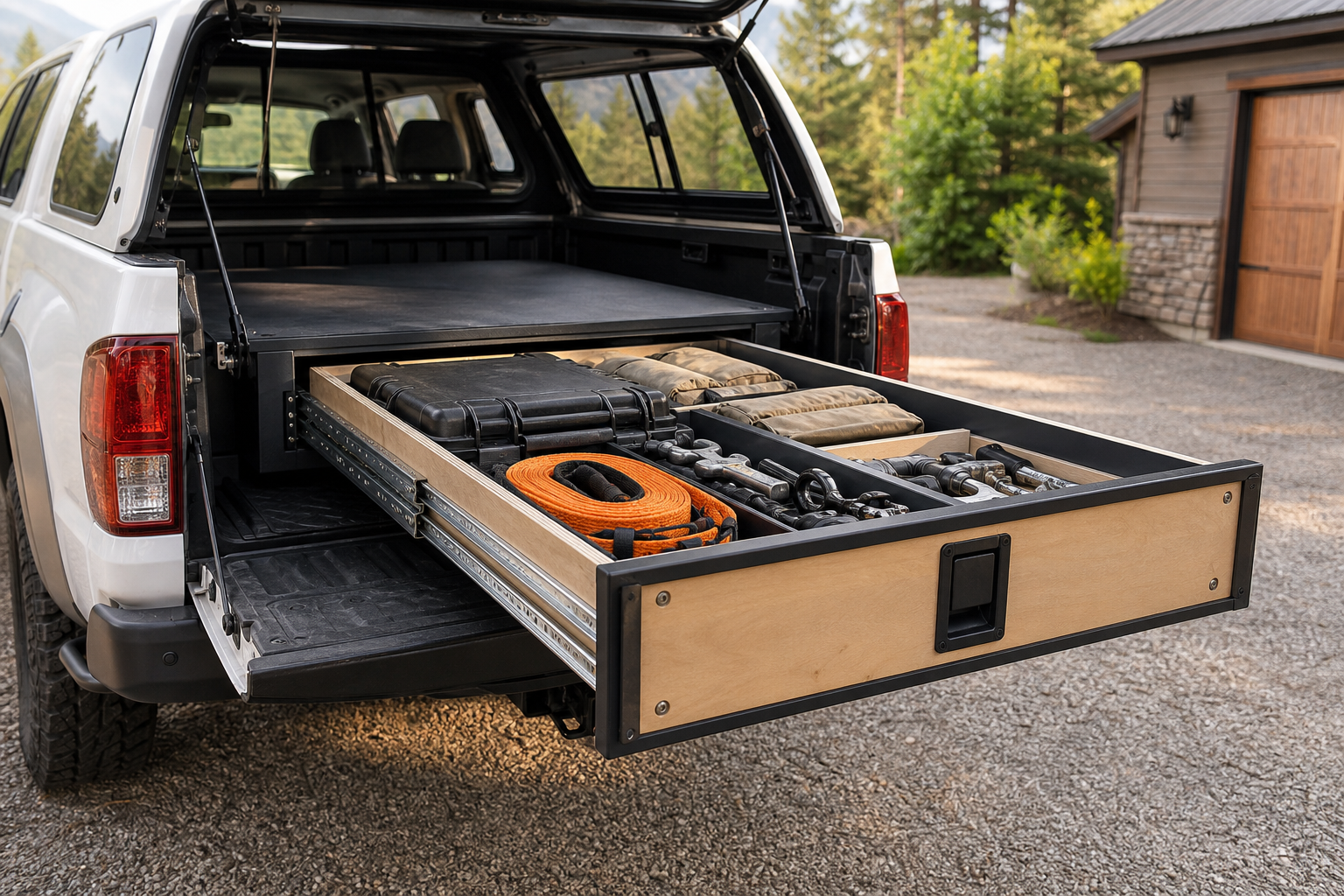
The right starting point is a heavy-duty, full-extension, side-mount slide designed for mobile loads, with the closed and open positions controlled. “Heavy-duty” alone is not enough: verify the mobile-use rating, drawer width, length, side clearance, release access, frame stiffness, and the loaded vehicle application.
Direct answer
Choose for the moving vehicle, not the empty drawer.
For a general-purpose pickup drawer, prioritize a published mobile-use capacity, full extension, lock-in, lock-out, a non-flexing side-mount frame, and a release you can reach with the drawer face installed. Add the drawer, tray, handles, dividers, and maximum cargo to get the working load; then verify that configuration against the exact slide documentation.
Decision order
Six filters, in the order that prevents expensive rebuilds.
- 01Define the working load
Count the empty drawer, drawer face, locks, handles, dividers, fridge or equipment tray, and the heaviest cargo combination you will actually carry.
- 02Verify mobile-use conditions
Stationary and mobile ratings can differ. Check the exact technical sheet for drawer width, slide length, cycle basis, orientation, and vehicle use.
- 03Control closed and open positions
Lock-in prevents unintended opening in transit; lock-out supports access on uneven ground. Confirm the model provides both—not just a light hold-in detent.
- 04Fit the closed length and side space
Measure at rail height, use the shorter of left/right depths, and size the drawer only after measuring the actual pair of slides.
- 05Keep the release reachable
Test the handle, lever, or single-side release with the drawer face, bumper, tailgate, cargo, and gloves in place.
- 06Build and test the frame as a system
Rails must stay parallel through full travel. Load gradually, cycle the drawer, and check fasteners, frame movement, lock engagement, and clearance before road use.
Load worksheet
Calculate what the slides will move.
Do not apply an invented universal safety multiplier. Mobile-use design depends on the exact slide, drawer width, length, mounting structure, road environment, and manufacturer conditions.
Use-case matrix
Match the slide features to what the drawer does.
| Truck-bed use | Primary concern | Slide features to verify | Also check |
|---|---|---|---|
| Recovery and tool drawer | Dense, changing cargo | Mobile load rating, full extension, lock-in/out | Dividers, front-heavy loading, frame fasteners |
| Camp kitchen drawer | Stable access while open | Lock-out, reachable release, smooth full travel | Tailgate work area, stove heat, uneven ground |
| Fridge or cooler tray | Concentrated equipment load | Mobile rating, lock positions, travel length | Lid swing, ventilation, wiring, tie-downs |
| Light occasional storage | Cost and basic access | Published vehicle suitability and hold-closed method | Do not assume a cabinet rating covers road use |
Why mobile rating matters
Stationary capacity is not automatically vehicle capacity.
Manufacturer evidenceAccuride’s 9300 documentation provides a concrete example: the same family publishes different stationary and mobile capacities and identifies lock-in/lock-out variants for vehicular compartments. That does not set COREAX capacity; it demonstrates the questions any truck-drawer slide specification should answer.
- Accuride 9300 SeriesOfficial product-family page showing separate stationary/mobile use examples, full extension, and lock-in/lock-out configurations for utility and emergency trucks.
- Accuride Mobile Applications guideStates that slide length and drawer width affect capacity, identifies vibration-tested models, and calls for application testing and added locking where needed.
Evidence boundary: The cited ratings apply only to the named Accuride models and conditions. COREAX LD2053 claims below come from the current COREAX catalog and are not presented as equivalent test results.
Common wrong turns
What usually causes the rebuild.
A large number without mobile conditions, drawer width, length, orientation, or frame requirements is incomplete.
Nominal descriptions do not replace the actual slide thickness and the tolerance your installation requires.
Lock-out stabilizes the open drawer; it does not level the truck or make an overloaded, forward-heavy drawer safe.
The rails can still bind when plywood, aluminum, or welded supports move out of parallel under extension.
COREAX product fit
LD2053 is the COREAX starting point for truck drawers.
COREAX LD2053 heavy-duty slides are cataloged in 12–40 inch nominal lengths with full extension, lock-in, lock-out, single-side release, side mounting, and up to 265 lb capacity. Use the product page to select a size, then confirm the exact variation, actual pair dimensions, working load, frame, fasteners, and intended road use before building.
FAQ
What type of drawer slide is best for truck bed drawers?
A heavy-duty, full-extension, side-mount slide with published mobile-use conditions and positive closed/open control is the best starting point. The exact choice still depends on working load, drawer width, length, frame, clearance, and release access.
Should truck bed drawer slides lock open and closed?
For many builds, yes. Lock-in controls the drawer during transit and lock-out keeps it extended while loading. Verify both functions on the exact model and test them with the drawer loaded.
Is the stationary load rating enough for a truck drawer?
Not by itself. Vehicle vibration, road shock, drawer width, length, mounting structure, and changing cargo can alter the application. Look for mobile-use conditions or obtain guidance for the intended installation.
How do I size slides for a truck bed drawer?
Measure usable closed depth at rail height, use the shorter side, account for rear obstructions, measure the actual slide thickness for drawer width, and verify the full-extension path beyond the tailgate or enclosure.
Added a six-filter decision path, working-load worksheet, truck-use matrix, mobile-vs-stationary evidence, failure modes, COREAX claim boundary, and fit-support route.
Move to the next decision.
Use the next guide in the same planning path, then verify the exact product before ordering.