
Heavy-Duty Slide Fastener Guide
What screws should you use for heavy-duty drawer slides?
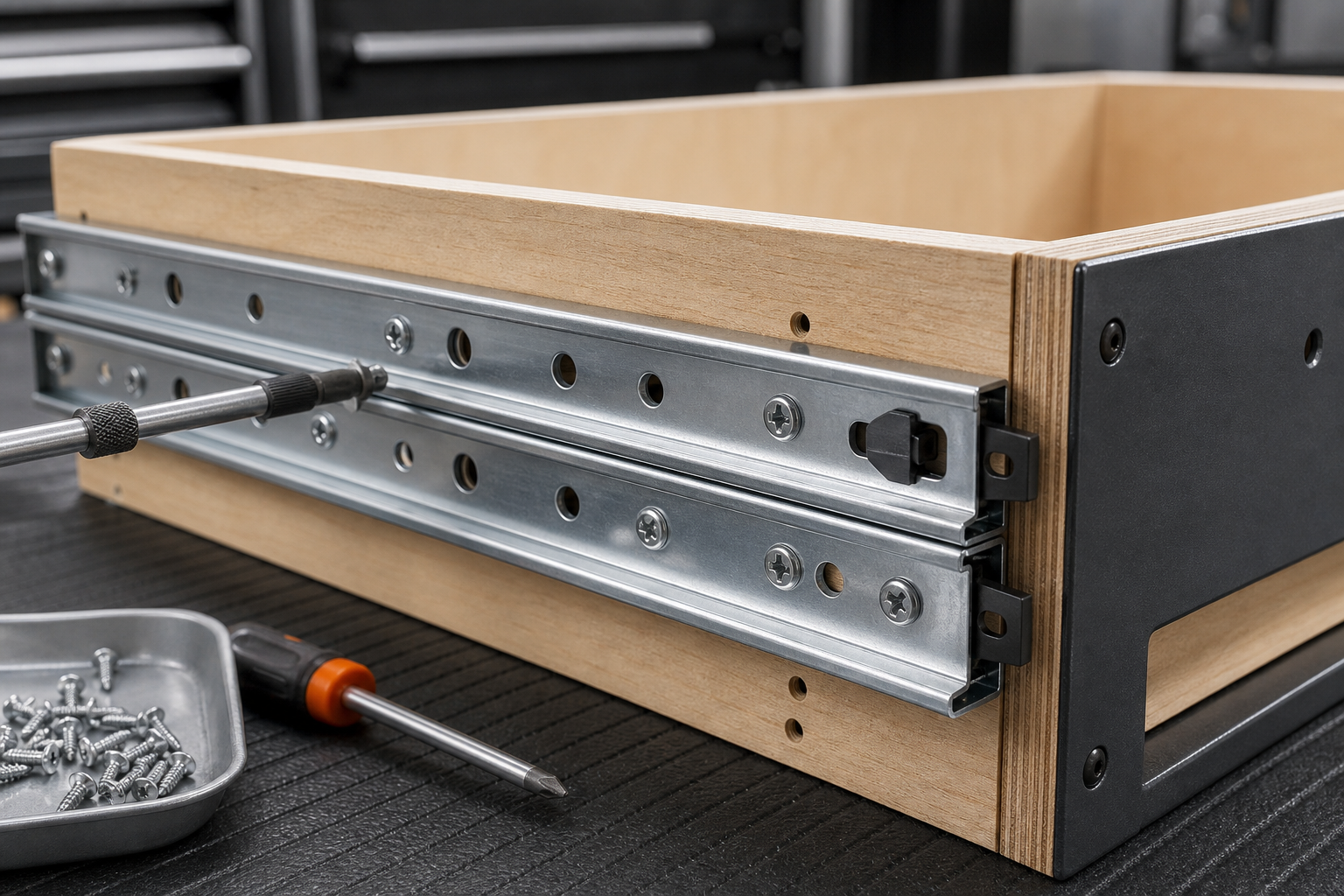
Use fasteners that fit the slide holes, keep their heads outside the moving rail path, develop adequate grip in the actual frame material, and remain serviceable under the expected load and vibration. Supplied screws can help position the slides, but they are not automatically the final structural fastener for plywood, solid wood, steel, aluminum, or a vehicle frame.
- Published by
- COREAX
- Technical review
- COREAX Product Support
- Published
- Updated
Direct answer
Match the fastener to four things at once.
The correct fastener must match the slide hole or slot, the mounting substrate, the required grip or embedment, and the moving-member clearance. Start with low-profile heads that seat flat against the rail. Then choose wood screws, machine screws, through-bolts, rivet nuts, threaded inserts, or other project fasteners according to the frame material and access.
Do not select only by diameter. A tall pan head can rub the inner member. A long wood screw can exit a thin panel. A self-drilling screw can strip thin sheet metal. A bolt can crush plywood without a washer or backing plate. The completed connection is a system.
Material-specific matrix
Choose a connection method for the actual mounting face.
| Mounting material | Common starting options | Main checks | Avoid |
|---|---|---|---|
| Quality plywood | Appropriate low-profile wood or cabinet screws; through-bolts where rear access permits | Panel thickness, edge distance, pilot hole, thread engagement, washer or backing, repeated removal | Overlong screws, coarse overtightening, fastening too close to an unsupported edge |
| Solid wood | Low-profile wood screws or bolts selected for species and section thickness | Pilot hole, splitting risk, grain direction, embedment, seasonal movement | Oversized diameter without pilot holes, end-grain-only anchorage for high loads |
| Steel tube or plate | Machine screws into tapped holes, through-bolts, rivet nuts, or suitable self-drilling screws where documented | Steel thickness, thread engagement, access, corrosion compatibility, vibration retention | Assuming a thin sheet provides adequate threads, protruding bolt ends in the rail path |
| Aluminum extrusion or plate | T-nuts, machine screws, through-bolts, threaded inserts, or rivet nuts suited to the section | Wall thickness, thread stripping, galvanic compatibility, washer area, extrusion-slot geometry | Overtorquing soft threads, mixing metals without considering corrosion |
| Composite or plastic panel | Through-bolts with large washers/backing plates or inserts specifically rated for the material | Creep, crushing, temperature, pull-through, local reinforcement | Relying on ordinary wood-screw threads in thin unsupported plastic |
| Vehicle body sheet metal | Engineered bracket, backing plate, rivet nut, through-bolt, or manufacturer-approved attachment | Structural location, hidden wiring, fuel/brake lines, corrosion protection, crash and regulatory implications | Drilling arbitrary body panels or treating trim sheet as a structural rail face |
This matrix is a planning aid, not a fastener schedule. Safety-critical vehicle, structural, marine, or public-use installations may require an engineer, fabricator, vehicle-body specialist, or applicable code review.
Head geometry
The screw head must disappear from the moving path.
Drawer slides telescope with small internal clearances. Mounting holes may be visible only at certain positions, and the moving member can pass directly over a fastener. A head that stands slightly proud can cause clicking, grinding, a hard stop, metal shavings, or a drawer that feels smooth empty and binds under load.
After installing each fastener, move the slide through its complete travel by hand before adding the drawer. Watch and feel for contact at every member transition.
Hole strategy
Use slots for alignment and round holes for final restraint.
Many slides include elongated slots and round holes. Slots allow small position adjustments during initial alignment. Round holes reduce the chance that the rail shifts after the final position is established. Use the exact product drawing and accessible hole pattern rather than assuming every visible opening is intended for a structural fastener.
- 01Position with selected slots
Install a limited number of fasteners loosely so the rail can still move during alignment.
- 02Cycle the slide
Check parallelism, front height, rear height, lock engagement, and screw-head clearance.
- 03Load gradually
Observe whether the frame spreads, twists, or pulls the rails out of alignment.
- 04Add final fasteners
Use the product’s intended round holes and the connection method selected for the substrate.
- 05Retest and inspect
Confirm no fastener moved, stripped, loosened, or entered the rail path.
Wood frames
Panel thickness and edge condition matter as much as screw length.
In plywood frames, the screw must develop useful thread engagement without exiting the panel or splitting a narrow edge. A screw installed into the face of quality plywood generally has a different holding condition from one driven into the edge of a thin panel. Through-bolts and backing plates can improve serviceability where the rear face is accessible, especially for long rails or repeated vehicle vibration.
Predrill when required by screw diameter, wood species, edge distance, or manufacturer instructions. The pilot hole should reduce splitting without removing the thread engagement needed for the connection. Do not overtighten until the rail deforms or the plywood surface crushes. If the drawer will be removed repeatedly, threaded inserts or through-bolts may be more maintainable than repeatedly driving wood screws into the same holes.
Metal frames
Thread engagement and panel thickness control the connection.
A tapped hole in substantial steel, a nut behind a through-bolt, a correctly installed rivet nut, and a self-drilling screw in thin sheet are not equivalent. Thin metal can strip or deform before the slide reaches its load capacity. Use the fastener manufacturer’s data for the exact substrate thickness and application, and consider backing plates where the rail loads concentrate on a small wall area.
For aluminum, protect against thread stripping and galvanic interaction between dissimilar metals, moisture, and salts. For steel vehicle frames, protect drilled edges and exposed metal against corrosion. Keep swarf away from bearings and clean the slide before operation.
Vibration and retention
A fastener that stays tight in a cabinet may loosen in a vehicle.
Road vibration, repeated lock engagement, drawer impact, and frame flex can reduce clamp load. Select a retention method appropriate to the joint: prevailing-torque locknuts, properly selected thread-locking compound, lock washers where suitable, mechanical locking features, or a documented torque procedure. The correct method depends on fastener size, material, temperature, disassembly needs, and manufacturer instructions.
Do not apply thread-locking compound to wood screws or plastics without confirming compatibility. Do not use a locking method as a substitute for adequate thread engagement or joint design. Inspect high-use vehicle drawers after initial service and periodically thereafter.
Included hardware
Package screws do not know what your frame is made from.
COREAX products may include mounting hardware for the intended product package, but a custom installation can use plywood, steel tube, aluminum extrusion, sheet metal, composite panels, or a combination. Treat included screws as part of the package inventory—not automatic approval for every substrate and load.
Installation inspection
Use a symptom-to-fastener check before blaming the slide.
Evidence and fastener boundaries
Fastener data is application-specific.
Manufacturer sourcesSimpson Strong-Tie’s Fastening Systems Technical Guide publishes load tables, material and corrosion information, spacing diagrams, and installation requirements for specific fastening products. Its general installer guidance warns that incorrect fastener quantity, size, placement, type, material, or finish can cause a connection to fail. These principles support selecting a documented connection instead of guessing from appearance.
- Simpson Strong-Tie Fastening Systems Technical GuideOfficial load, material, corrosion, spacing, and installation data for model-specific fasteners.
- Simpson Strong-Tie General Installer InstructionsOfficial warning that fastener quantity, size, placement, type, material, and finish must match the specified connection.
Evidence boundary: These sources do not specify one universal screw for COREAX slides. Final fastener choice depends on the selected rail, mounting holes, substrate, thickness, edge distances, load, vibration, environment, and applicable construction or vehicle requirements.
COREAX fit support
Send the substrate and access details, not only the slide size.
For fastener guidance, include the COREAX product and length, mounting-face material and thickness, whether the rear face is accessible, expected complete moving load, stationary or mobile use, corrosion exposure, and close photos of the rail holes and frame. COREAX can help identify fit questions, but safety-critical connections may require a qualified installer or engineer.
Common questions
Heavy-duty slide screw FAQ
What screw-head style is best for drawer slides?
Use a head that seats securely and remains below the moving-member clearance. Low-profile or suitable truss/pan heads are common, but the exact rail geometry controls the choice. Use countersunk screws only in holes designed for them.
Can I use the screws included with the slides?
Use them only when their head, diameter, length, material, and thread match the rail and your mounting substrate. Custom plywood, steel, aluminum, or vehicle structures may require different fasteners.
Are through-bolts better than wood screws?
They can provide a more serviceable clamped connection when both sides are accessible and the frame is designed for them. They still need correct head clearance, washers or backing, and protection from the rail path.
Why does my drawer click after I installed the screws?
A screw head, washer, bolt end, burr, or metal shaving may be contacting the moving member. Stop and inspect the exact travel point before continued use.
Added a substrate-specific fastener matrix, head-clearance guidance, slot/round-hole installation sequence, wood and metal connection checks, vibration retention, supplied-hardware boundary, inspection table, sources, and FAQ.
Move to the next decision.
Use the next guide in the same planning path, then verify the exact product before ordering.