
Overland Storage System Guide
Overland drawer system hardware guide.
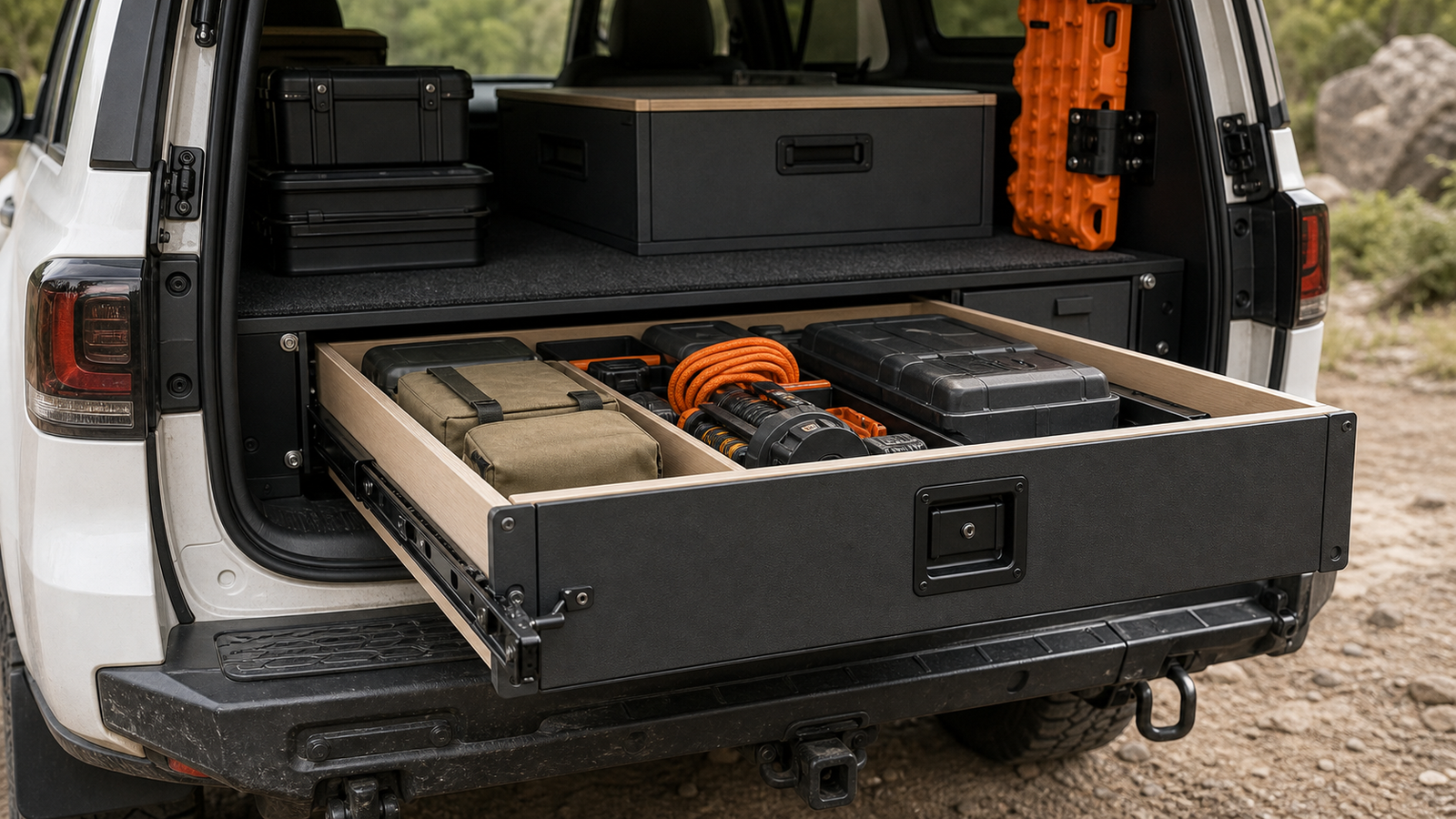
Plan an overland drawer system as a vehicle subsystem: frame, drawers, slides, locks, cargo restraint, fridge or kitchen tray, power and water routing, dust and moisture control, service access, recovery-gear priority, fold-away work surfaces, and field repair. Hardware selection comes after the system architecture.
- Published by
- COREAX
- Technical review
- COREAX Product Support
- Published
- Updated
Direct answer
Design access, restraint, and repair before choosing the slide.
An overland drawer system must keep critical gear reachable, remain closed over rough roads, avoid overloading the vehicle, and allow repairs away from a workshop. Start with the vehicle payload and mounting boundary. Map recovery gear, water, fridge, kitchen, tools, power, sleeping platform, and daily-use items. Then size the frame and drawer modules and choose slides, latches, fasteners, and folding hardware for each function.
A single product family rarely solves every module. Heavy locking side-mount slides suit large vehicle drawers and appliance trays. Bottom-supported slides can suit lighter interior shelves. Folding brackets can create a prep surface when attached to adequate structure. External latches, tie-downs, dividers, seals, and cable management remain separate systems.
System architecture
Divide the build by function and failure consequence.
| Module | Primary requirement | Hardware path | Failure consequence |
|---|---|---|---|
| Recovery drawer | Immediate access and dense load control | Heavy locking slides, rigid frame, dividers, positive latch | Recovery equipment unavailable or shifting during travel |
| Tool and spare-parts drawer | High-density organization and serviceability | Full extension, strong drawer box, removable bins, field-accessible fasteners | Excess rattle, overload, difficult roadside repair |
| Fridge/cooler tray | Concentrated load, airflow, lid, cable, and restraint | Locking slide pair, appliance tie-down, service loop, rigid tray | Cooling failure, cable damage, appliance movement |
| Camp-kitchen module | Clean work area and controlled heat/fuel | Locking tray, folding surface, utensil retention, ventilation | Fire, spill, unstable cooking surface, contaminated storage |
| Water storage | Large changing mass and leak control | Fixed low mounting, rated restraint, drain/inspection access | Payload shift, leakage, high center of gravity |
| Electrical module | Ventilation, isolation, cable protection, service access | Fixed enclosure, grommets, disconnects, qualified electrical design | Heat, short circuit, damaged cables, inaccessible fuse/service points |
| Sleeping platform | Human-support structure and egress | Purpose-designed structure; not ordinary drawer slides alone | Injury, blocked exit, structural collapse |
Vehicle payload
The storage system consumes payload before it carries gear.
Count the frame, drawer boxes, slide pairs, locks, deck, fridge tray, brackets, fasteners, electrical equipment, water containers, and permanent accessories. Then add maximum cargo, passengers, fuel, and other vehicle loads according to the vehicle documentation. Heavy-duty slides can solve drawer movement while making the vehicle payload problem worse if the system is oversized.
Keep dense items low and near strong vehicle attachment zones. Do not use drawer convenience to move every heavy item to the rear of the vehicle. Axle load, handling, braking, crash performance, and manufacturer limits require vehicle-specific assessment.
Access priority
Place gear by when and where it is needed.
Slide choice
Choose by module, not one slide for the entire build.
Use Best Drawer Slides for Truck Bed Drawers for product filtering and the heavy-duty selection guide for detailed measurements.
Locks and restraint
Control the drawer, cargo, and compartment independently.
Lock-in and lock-out control the slide end positions. Internal dividers or straps control cargo. An external latch can provide additional closed restraint and theft resistance. The vehicle attachment controls the complete drawer frame. Treat each layer separately and verify that one layer does not block another.
- Slide lock fully engages with the drawer loaded.
- External latch can be inspected and operated from the intended position.
- Internal bins cannot jump into the lock or rail path.
- Fridge, battery, and equipment are attached to the tray or frame.
- Drawer face and handles do not become the only impact stop.
- Custom linkage cannot be pulled by shifting cargo.
- The entire system is attached to appropriate vehicle structure.
Dust, water, and cleaning
Seal the cargo zone without trapping moisture.
Dust enters through tailgates, hatches, floor seams, drawer gaps, and pressure changes. Water enters through wet gear, coolers, condensation, washing, and vehicle openings. A completely sealed drawer can still trap moisture. Plan removable liners, drainage paths, cleanable surfaces, corrosion-resistant fasteners where appropriate, and bearing protection.
Power, water, and fuel
Moving trays need controlled utility routes.
Power cables, fridge leads, water hoses, drain lines, gas lines, and fuel systems have different safety requirements. Avoid routing a moving line casually through a drawer system. Use appropriate grommets, strain relief, bend radius, isolation, shutoff, and qualified installation. Keep utilities away from sharp rail edges, lock levers, heat, and pinch points.
Do not combine a generic drawer guide with electrical, gas, fuel, or potable-water design. Follow the equipment manufacturer and applicable codes. A slide tray can provide access, but it does not establish that a moving connection is permitted.
Fold-away work surfaces
Add a table only after the support and heat zones are defined.
Folding brackets can add a prep shelf or work surface to a drawer module, but the bracket loads must enter adequate backing. The surface should not block a release handle, drawer path, tailgate, exhaust, burner, or emergency gear. In a moving vehicle, secure the folded surface independently for travel.
Continue to How to Choose Folding Shelf Brackets.
Field service
Design so one damaged module does not disable the entire system.
- Use accessible fasteners and document hidden attachment points.
- Keep a manual method to release or remove a drawer if the linkage fails.
- Separate electrical and water service panels from cargo removal.
- Use repeatable hardware sizes where practical.
- Carry appropriate spare fasteners, latch parts, and basic adjustment tools.
- Do not permanently bury factory vehicle service items.
- Record slide SKU, length, installation width, and replacement path.
- Provide a way to secure a failed drawer closed for safe travel.
Build sequence
Prototype access before finishing the cabinet.
- 01Confirm vehicle limits and mounting zones
Review payload, body structure, factory attachment points, wiring, fuel, airbags, and service access.
- 02Lay out modules with full-size mockups
Test tailgate, hatch, seat, sleeping, fridge lid, and user-standing positions.
- 03Calculate system and module loads
Use real equipment and maximum water/cargo conditions.
- 04Select hardware by module
Choose slide, latch, bracket, fastener, tie-down, and utility route separately.
- 05Build and test the unfinished frame
Cycle drawers, operate all lids and doors, test locks, and load gradually before final panels.
- 06Finish, document, and inspect after travel
Record measurements and fasteners, then check the system after initial road and off-road use.
Evidence and vehicle boundary
Mobile slide conditions and structural connections must remain explicit.
Manufacturer sourcesAccuride’s 9300 family publishes different stationary and mobile examples and identifies lock variants for vehicle compartments. Simpson Strong-Tie’s fastening guide illustrates that fastener loads, spacing, substrate, installation, and corrosion conditions are product-specific. These sources support treating the slide and frame connection as documented components inside a larger vehicle system.
- Accuride 9300 SeriesOfficial example of separate mobile/stationary load conditions and lock-in/out vehicle-compartment variants.
- Simpson Strong-Tie Fastening Systems Technical GuideOfficial model-specific fastener load, material, spacing, corrosion, and installation information.
Evidence boundary: This page is not vehicle engineering, crash certification, payload approval, electrical/gas design, or a COREAX laboratory test report. Follow the vehicle and equipment manufacturers and applicable law. COREAX specifications apply only to the selected products and documented installation conditions.
COREAX hardware path
Bring a system diagram to the product decision.
Use LD2053 for applicable 12–40 inch drawers and trays needing integrated one-side release. Use L2576 for applicable 20–60 inch custom frames with a validated linkage. Use COREAX folding brackets only where adequate backing and a separate travel restraint support the fold-away surface.
Common questions
Overland drawer system FAQ
What hardware does an overland drawer system need?
Common systems use a rigid frame, suitable drawer slides, closed/open restraint, cargo dividers or tie-downs, vehicle attachment, serviceable fasteners, and sometimes fridge trays or folding work surfaces. Each module needs its own load and safety review.
Should every overland drawer use the highest-capacity slide available?
No. Oversized slides add weight, cost, profile, and frame demand. Choose the product whose selected-size rating, release, length, and mobile-use conditions fit the complete module.
Can drawer locks secure loose recovery gear?
No. Slide locks control the drawer position. Internal cargo needs dividers, bins, straps, or other restraint so it cannot shift into the face, locks, or slide path.
Can folding brackets support a sleeping platform?
Do not assume ordinary shelf brackets or drawer slides are suitable for human support. A sleeping or seating platform requires purpose-designed structure and appropriate engineering.
Expanded with module planning, payload and access priorities, layered restraint, dust and water control, utilities, fold-away surfaces, field repair, build sequence, product selection, and common questions.
Move to the next decision.
Use the next guide in the same planning path, then verify the exact product before ordering.